
Introduction
Attacks on the software supply chain are now among the fastest-growing threats facing development teams everywhere. As companies lean more heavily on open-source libraries, automated deployment pipelines, and third-party integrations, attackers keep finding fresh ways to poison software long before it ever reaches production.
Recent events have shown that a single compromised package can ripple out to affect thousands of developers and businesses at once. The return of the Mini Shai-Hulud campaign is the latest proof that attackers no longer limit themselves to applications and infrastructure — they’re now going after the software development lifecycle itself.
By abusing trusted development tools, package registries, and CI/CD systems, bad actors can push malicious code at scale while staying largely under the radar. The fallout from this kind of attack can include stolen credentials, unauthorized changes to code, leaked data, and major disruptions to daily operations.
This article looks at what happened during the Mini Shai-Hulud incident, how supply chain attacks play out inside CI/CD environments, and what practical steps engineering teams can take to shore up their defenses.
How Supply Chain Attacks Have Evolved: From SolarWinds to Mini Shai-Hulud
Supply chain attacks aren’t new, but they’ve grown far more advanced and far-reaching over the last several years.
The SolarWinds breach remains one of the clearest examples: attackers broke into a trusted vendor and pushed tampered updates out to thousands of customers. That incident made it obvious how compromising just one link in the software supply chain can open the door to countless organizations at the same time.
Since then, attackers have turned their focus toward open-source ecosystems like npm, PyPI, Maven, and RubyGems. These registries host millions of packages that developers pull in every day to move faster. Open-source software brings enormous value, but it also creates new exposure whenever a maintainer account, a dependency, or a build pipeline gets compromised.
Why Modern Supply Chain Attacks Are Different
Mini Shai-Hulud marks the next chapter in this pattern. Rather than going after one company at a time, the campaign used the tightly connected nature of the development ecosystem to push malicious code through workflows developers already trust.
The takeaway for organizations today is simple: security can’t stop at the edge of production anymore. The development pipeline itself is now a prime target.
What Counts as a Software Supply Chain Attack?
A software supply chain attack happens when someone compromises a tool, dependency, component, or process that’s part of how software gets built and shipped.
Instead of hitting an application head-on, attackers go after the trusted pieces developers rely on every day. Once one of those pieces is compromised, it can become a delivery vehicle for malicious code.
Typical entry points for this kind of attack include:
- Malicious open-source packages
- Compromised package maintainer accounts
- Stolen publishing credentials
- Vulnerable third-party dependencies
- Compromised CI/CD pipelines
- Tampered software updates
- Leaked secrets and access tokens
At the core of all of this is an abuse of trust. Developers generally assume that approved dependencies, established repositories, and automated pipelines are safe to use
Common Entry Points for Supply Chain Attacks
Attackers exploit exactly that assumption to spread malware, steal credentials, or quietly gain access to systems they shouldn’t be in.
Because so many pieces of a software supply chain are interconnected, one breach can cascade quickly across teams, organizations, and end customers.
Why Developers Have Become Prime Targets
Attackers used to focus their energy on production servers, databases, and end-user devices. These days, developers themselves have turned into one of the most valuable targets around.
Developers typically have access to things like:
- Source code repositories
- CI/CD pipelines
- Cloud infrastructure
- API keys
- Deployment credentials
- Internal development tools
Get into one developer’s account, and you may get a foothold into several systems at once.
Modern attackers zero in on developer environments precisely because they open a path into a much larger corporate infrastructure. Once an attacker has hold of tokens or secrets, they can hop laterally across repositories, cloud services, and deployment tools.
Mini Shai-Hulud is a textbook case of this approach. Instead of going straight after production systems, the campaign concentrated on harvesting credentials and riding on trusted development workflows to spread further.
As more organizations lean into DevOps, protecting developer environments has become just as critical as locking down production.
Breaking Down the Mini Shai-Hulud Incident
Mini Shai-Hulud surfaced as a sophisticated supply chain attack aimed squarely at the npm ecosystem.
The campaign relied on malicious packages built to slip into developer environments, pull out sensitive credentials, and spread through channels developers already trusted. By hijacking publishing mechanisms and riding on the reputation of established package ecosystems, the attackers boosted the odds that developers would install the infected packages without a second thought.
What set this attack apart was its ability to spread on its own. Rather than staying contained to one machine, the malware actively hunted for ways to expand — going after development credentials, repositories, and connected infrastructure.
Key Security Weaknesses Exposed
The incident exposed a handful of recurring security gaps:
- Development workflows granted more permissions than they needed
- Weak or inconsistent monitoring of package activity
- Poor credential management practices
- Too much blind trust placed in the open-source ecosystem
- Insufficient vetting of third-party dependencies
For engineering teams, the incident is a reminder that supply chain security isn’t a one-time checkbox — it demands constant attention throughout the entire development lifecycle.
Breaking Down the Mini Shai-Hulud Attack Chain
Knowing how these attacks actually unfold can help teams spot and close gaps before attackers find them.
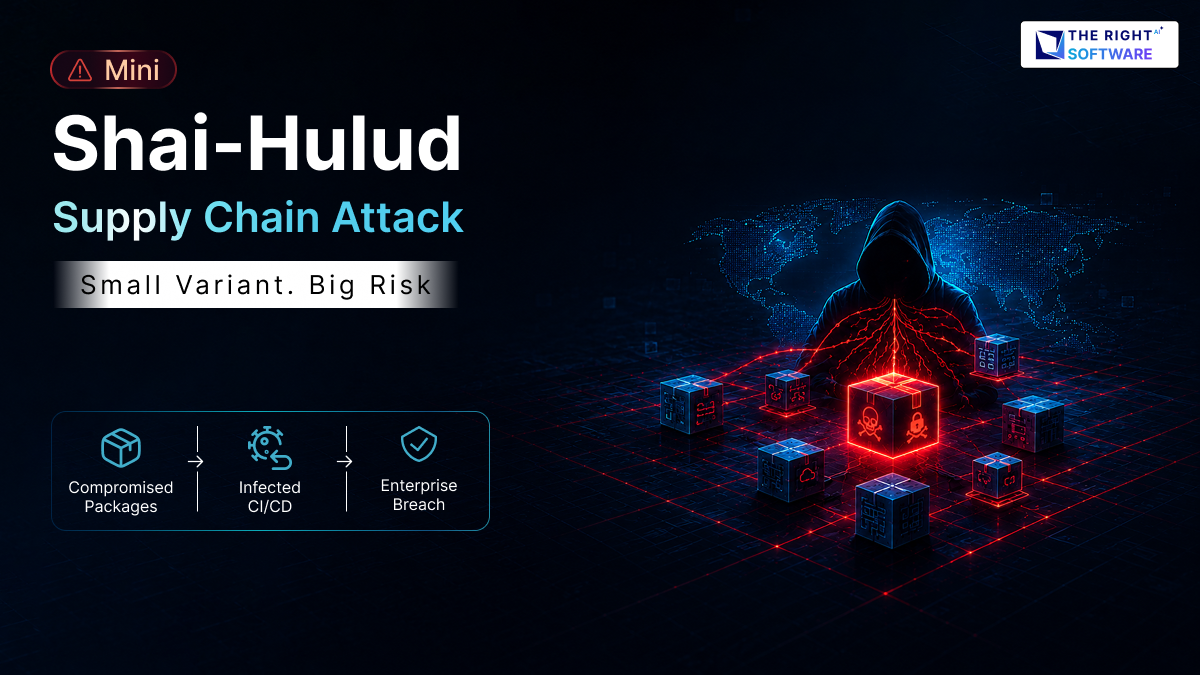
A simplified version of the attack chain looks like this:
1. Initial Compromise
Attackers get their hands on a trusted account, package, repository, or publishing pipeline — often through stolen credentials, phishing, or a leaked token.
2. Malicious Package Distribution
With that access secured, attackers publish or tamper with packages that look completely legitimate to anyone downloading them.
3. Package Installation
Developers pull in the compromised package as part of their everyday workflow, with no idea that anything is wrong.
4. Credential Harvesting
The malicious code goes searching for valuable targets such as:
- GitHub tokens
- Cloud credentials
- Environment variables
- API keys
- CI/CD secrets
5. Lateral Movement
Armed with stolen credentials, attackers try to push into additional repositories, services, and development systems.
6. Self-Propagation
The malware keeps spreading by targeting other repositories, workflows, or environments tied to the credentials it’s already stolen.
This chain of events shows exactly why supply chain attacks can escalate so quickly once attackers get that first foothold.
Why Trust Alone No Longer Cuts It
For a long time, developers leaned on signals like verified publishers, well-known package maintainers, trusted repositories, and automated release pipelines to decide whether a dependency was safe to use. Those signals still matter, but incidents like Mini Shai-Hulud make one thing clear: trust by itself isn’t enough anymore to guarantee software supply chain security.
Attackers have learned to go straight after the systems that create trust in the first place. If a maintainer’s account gets hijacked or a publishing token leaks, a malicious package can look completely legitimate even though it’s coming from a source everyone assumed was safe.
Moving from Trust to Continuous Verification
That’s what makes this so dangerous — security teams can end up assuming a verified package is safe purely because of who published it, without actually checking the package itself.
Real supply chain risk management means shifting away from trust-based assumptions toward continuous verification. Every dependency, package, and deployment artifact needs to be evaluated for risk on an ongoing basis, no matter where it came from.
That shift means putting these practices to work:
- Continuous dependency monitoring
- Package integrity verification
- Software provenance validation
- Behavioral analysis of packages and workflows
- Runtime monitoring of production systems
Trust still has a role to play, but verification-based security is what modern software supply chain protection actually depends on.
How CI/CD Pipeline Attacks Play Out
CI/CD pipelines exist to automate software delivery — they speed up development, cut down manual work, and let teams ship releases far more often.
That same automation is exactly what makes CI/CD security such an attractive target for attackers.
A compromised CI/CD pipeline can hand attackers a direct line into:
- Source code repositories
- Production deployment systems
- Cloud infrastructure
- Environment variables
- Build artifacts
- Customer-facing applications
Unlike an attack limited to one machine or service, a compromised pipeline can taint every single application that flows through that workflow.
How Attackers Move Through CI/CD Pipelines
Attackers go after CI/CD pipelines because they act as a central connector linking multiple systems together. Once inside, they’re able to:
- Slip malicious code into builds
- Alter deployment configurations
- Steal credentials and secrets
- Push out compromised software releases
- Stay embedded inside development environments long-term
Mini Shai-Hulud made it painfully clear that attackers now see CI/CD infrastructure as a strategic doorway into an organization, not just a productivity tool.
That’s exactly why pipeline security deserves a central place in any organization’s broader cybersecurity strategy.
Where Modern Dev Workflows Fall Short
Plenty of engineering teams open themselves up to supply chain risk without realizing it, simply through everyday workflow habits.
Overly Broad Permissions
CI/CD workflows often run with far more access than they actually need. The wider the permissions, the worse the damage if credentials are ever stolen.
Hardcoded Secrets
API keys, tokens, and other credentials sitting in source code remain one of the leading causes of security breaches.
Unvetted Dependencies
Pulling in packages without checking their source, reputation, or maintenance history is a fast way to introduce serious risk.
Weak Third-Party Integrations
External services and third-party API integrations plugged into development workflows can turn into attack vectors the moment their own security controls are lacking.
Blind Spots in Monitoring
Without visibility into package activity, pipeline execution, and deployment events, suspicious activity can slide by unnoticed.
Stale Dependencies
Old, unpatched packages often carry known vulnerabilities that attackers are already actively scanning for.
Closing these gaps takes a proactive, security-first mindset baked into the software development lifecycle — not a one-off audit.
The Business Fallout, Not Just the Technical One
It’s tempting to treat supply chain attacks as purely an IT problem, but the fallout reaches well beyond the engineering org.
When a pipeline gets compromised, companies can end up facing:
Operational Disruption
Teams may have to pause releases entirely while they investigate, contain, and rotate every exposed credential.
Financial Fallout
Incident response, forensics, recovery work, and remediation all eat into budget and engineering time.
Reputational Damage
Customers expect vendors to keep their products and infrastructure secure — a breach can quietly chip away at trust and brand reputation.
Compliance Exposure
Companies operating under regulatory requirements can face real penalties if sensitive data ends up exposed.
Delayed Releases
Security incidents routinely throw off development timelines and push back product launches.
The real cost of a supply chain attack usually runs far deeper than the initial breach — which is exactly why prevention is so much cheaper than cleanup.
Best Practices for CI/CD Pipeline Security
Adopt Least-Privilege Access
Least privilege is one of the strongest defenses against supply chain attacks available today.
Every user, service account, and automated workflow should only be able to reach the resources it actually needs.
To get there, teams should:
- Tighten workflow permissions
- Separate access across environments
- Cap administrative privileges
- Review access rights on a regular cadence
- Clean out unused accounts and tokens
Cutting down on permissions limits how much damage a stolen credential can actually do
Tighten Up Secret Management
Secrets are some of the highest-value targets in any development environment.
Credentials should never live directly inside source code repositories.
Instead, teams should:
- Rely on dedicated secrets management tools
- Rotate credentials on a set schedule
- Enforce strict access controls
- Audit how secrets are being used
- Auto-revoke credentials that go unused
Solid secret management dramatically cuts the odds of unauthorized access if something is ever compromised.
Run Continuous Dependency Scanning
Open-source dependencies bring huge value — and real risk right alongside it.
Dependency scanning tools help surface:
- Known vulnerabilities
- Malicious packages
- Outdated libraries
- License compliance issues
Security checks belong directly inside CI/CD workflows so risky dependencies get caught before they ever reach deployment.
Ongoing scanning keeps teams from losing visibility into their own software supply chain.
Use Code Signing and Provenance Verification
Code signing confirms that software actually came from a trusted source and wasn’t tampered with along the way.
Worth implementing:
- Signed build artifacts
- Formal release verification processes
- Provenance validation
- Secure, locked-down publishing workflows
These controls make it significantly harder for attackers to sneak unauthorized changes into a software release.
Keep Monitoring and Threat Detection Running
Prevention alone won’t cut it — teams also need real visibility into what’s happening across their environments.
Strong monitoring should cover:
- Pipeline execution logs
- Package installation activity
- Repository changes
- Credential usage patterns
- Deployment events
The quality of that visibility depends heavily on how logs are structured in the first place. Teams using canonical log lines — one well-structured log entry per request or event — tend to spot anomalies far faster than teams sifting through scattered, unstructured log output.
Continuous monitoring is what lets teams catch suspicious activity early and respond before it turns into a full-blown incident.
Lock Down GitHub Actions and Automation
Automation workflows are powerful, but a misconfigured one can open the door wide for attackers.
Security teams should:
- Restrict workflow permissions
- Require review before any workflow change ships
- Monitor how actions are being used
- Stick to trusted, verified actions only
- Rotate workflow credentials regularly
- Turn on multi-factor authentication everywhere it’s supported
Locking down automation platforms is one of the simplest ways to cut off unauthorized access and block malicious workflow tampering before it starts.
How TRS Helps Reduce Supply Chain Security Risks
As software supply chains keep growing more complex, organizations need security practices that go well beyond traditional application-level protection. At TRS, we believe securing modern software means having visibility and control across the entire development lifecycle — not just the finished product.
Security Best Practices We Recommend
Our approach builds security into every stage of the CI/CD pipeline, helping engineering teams cut down on risk from third-party dependencies, exposed credentials, and insecure workflows.
Here’s what a stronger security posture looks like in practice:
Security-Focused CI/CD Reviews
Development workflows need regular review to catch excessive permissions, misconfigurations, and potential attack paths before an attacker finds them first.
Dependency Risk Assessment
Every third-party package and library should be evaluated before it lands in a production environment. Routine dependency audits help flag vulnerable or abandoned packages before they become liabilities.
Secret Management Best Practices
Sensitive credentials belong in secure storage systems — not hardcoded into repositories, scripts, or configuration files.
Least-Privilege Access Controls
Access should only ever be granted when it’s truly needed, and scoped down to the minimum permissions required for the job at hand.
Continuous Monitoring and Observability
Keeping an eye on development workflows, deployment activity, and infrastructure events helps teams catch unusual behavior early — before a minor issue turns into a major incident.
A Security-First DevOps Culture
Tools and technology can’t solve everything on their own. Organizations need to build security awareness into their teams and weave security practices into everyday workflows, not treat them as an afterthought. That’s easier said than done given the ongoing cybersecurity skills shortage many engineering organizations are already grappling with — which makes baking security into tooling and process even more important than relying on headcount alone.
Put together, these practices meaningfully cut down exposure to modern supply chain threats — without slowing teams down or getting in the way of development speed.
A Practical CI/CD Security Checklist
Use this checklist to evaluate — and tighten up — your CI/CD security posture.
Access Control
- Enforce multi-factor authentication (MFA)
- Apply least-privilege permissions
- Review user access rights on a regular basis
- Remove inactive accounts and unused tokens
Secret Management
- Store secrets in a dedicated secrets manager
- Rotate credentials on a regular schedule
- Prevent secrets from ever being committed to a repository
- Keep an eye on credential usage
Dependency Security
- Scan dependencies continuously
- Review new packages before adopting them
- Remove dependencies that are no longer in use
- Track package reputation and maintenance activity
Pipeline Security
- Restrict CI/CD workflow permissions
- Route workflow changes through pull request review
- Secure your build environments
- Verify deployment integrity before release
Monitoring and Response
- Enable centralized logging
- Monitor pipeline activity in real time
- Flag unusual credential usage
- Have incident response procedures ready to go
Running through this checklist regularly helps teams find the gaps before attackers do.
Key Takeaways for Development Teams
The Mini Shai-Hulud incident leaves engineering teams with a few important lessons.
First, software supply chain attacks aren’t rare, isolated events anymore — they’ve become a go-to attack method precisely because one entry point can compromise multiple organizations at once.
Second, developers and CI/CD pipelines are now squarely in attackers’ crosshairs. Compromising development infrastructure often opens up more access than going after production systems directly ever would.
Third, trust alone doesn’t cut it. Dependencies, workflows, credentials, and build artifacts all need continuous verification throughout the software delivery lifecycle.
Fourth, visibility isn’t optional — it’s essential. Without real monitoring and observability, malicious activity can go undetected until real damage is already done.
Finally, supply chain security has to be an ongoing process, not a one-and-done project. New dependencies, tools, and integrations show up constantly, and each one adds fresh risk — which is exactly why continuous security review matters for long-term resilience.
Conclusion
The return of the Mini Shai-Hulud attack underscores a shift that’s well underway in modern software development: attackers are increasingly going after the software supply chain instead of traditional infrastructure.
As organizations keep adopting open-source tools, cloud-native architectures, and automated deployment pipelines, the attack surface available to threat actors just keeps expanding.
Defending against this requires a full security strategy — one that combines least-privilege access controls, solid secret management, dependency scanning, code signing, continuous monitoring, and strong CI/CD governance.
No organization can wipe out risk completely, but putting these best practices into place can dramatically cut down both the odds and the impact of a supply chain compromise.
The lessons from Mini Shai-Hulud are a clear reminder that software security isn’t just about writing secure code anymore. Organizations need to secure the entire development ecosystem — from the moment a dependency gets installed to the moment code reaches production.
By taking a proactive stance on supply chain security now, development teams can build systems that hold up better under pressure and stay ahead of whatever threats come next.
Your supply chain is only as strong as its weakest dependency.
Mini Shai-Hulud won’t be the last worm to exploit blind trust in packages, tokens, and pipelines. The teams that come out ahead are the ones who stop reacting to breaches and start building security into every stage of development. If your CI/CD pipeline still runs on trust instead of verification, now is the time to change that. Connect with The Right Software to build a supply chain security strategy rooted in least-privilege access, continuous monitoring, and structured, canonical logging.