
Introduction
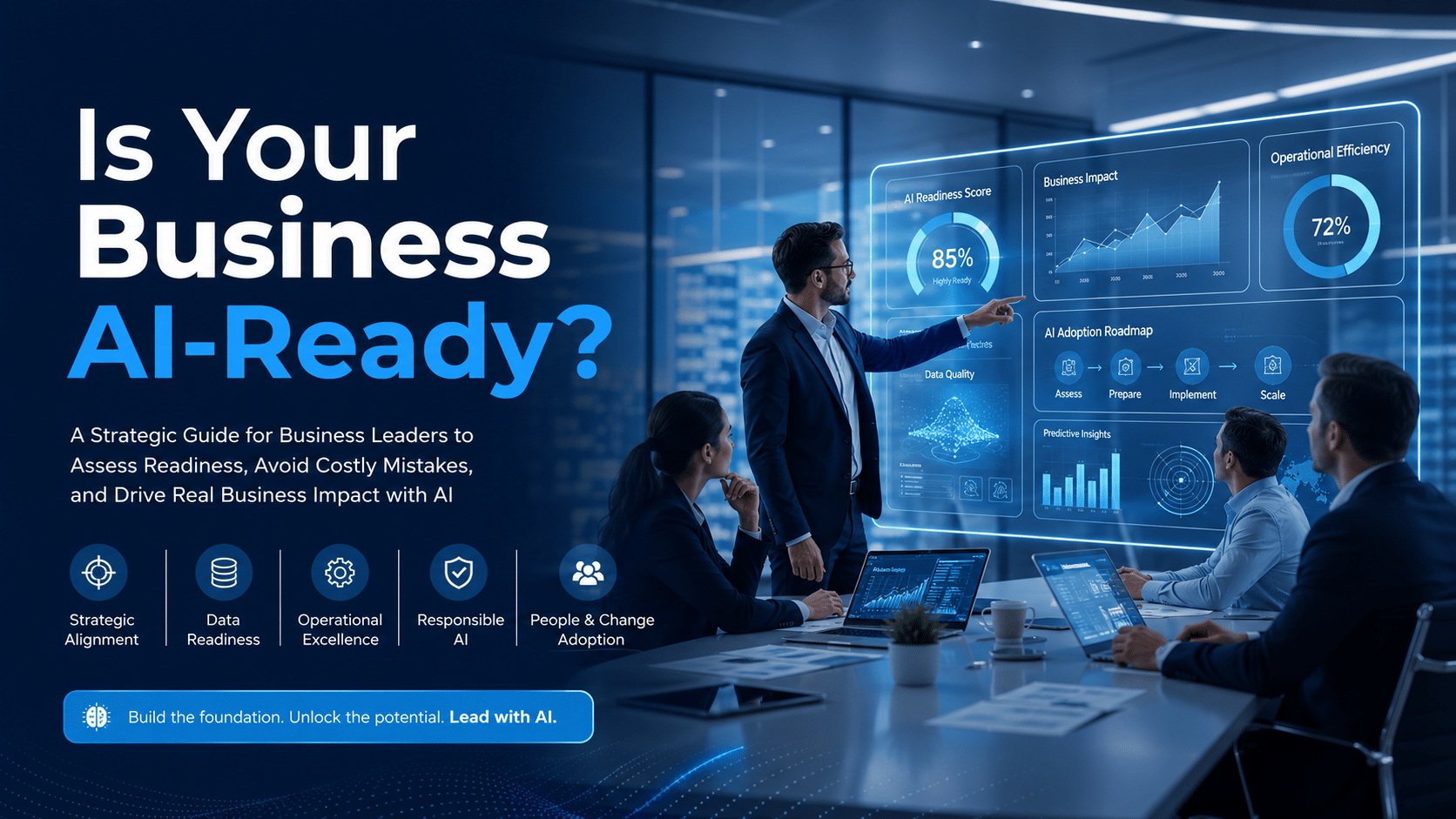
Artificial intelligence (AI) has rapidly evolved from an emerging technology into a boardroom priority. Organizations across industries are investing in AI to improve decision-making, automate operations, enhance customer experiences, and unlock new growth opportunities. Yet despite increasing investment, many AI initiatives fail to progress beyond the pilot stage or deliver the business value leaders expect.
According to Gartner, a significant percentage of AI projects will be abandoned due to challenges related to data readiness and organizational preparedness. This highlights a reality that many organizations overlook: successful AI adoption is about far more than technology. The challenge is not simply selecting the right platform or working with an experienced AI Development Company. It is ensuring that the business itself is prepared to adopt AI successfully.
Consider a common scenario. An organization launches an AI-powered solution expecting immediate efficiency gains. The technology performs as intended, but fragmented data, inconsistent processes, and unclear ownership prevent the business from realizing meaningful results.
The AI works.
The organization does not.
This is where many AI strategies begin to lose momentum. Organizations often focus on what AI can do before asking whether their business has the strategy, processes, data, governance, and leadership alignment required to turn AI into measurable outcomes.
Before asking:
“Which AI solution should we implement?”
leaders should first ask:
“Is our business ready for AI?”
Whether an organization is investing in AI Software Development, exploring AI Consulting services, or evaluating enterprise automation opportunities, readiness is the foundation that determines long-term success.
This article introduces a practical framework to help business leaders evaluate their organization’s AI readiness, identify potential gaps before implementation, and build a stronger foundation for scalable AI adoption.
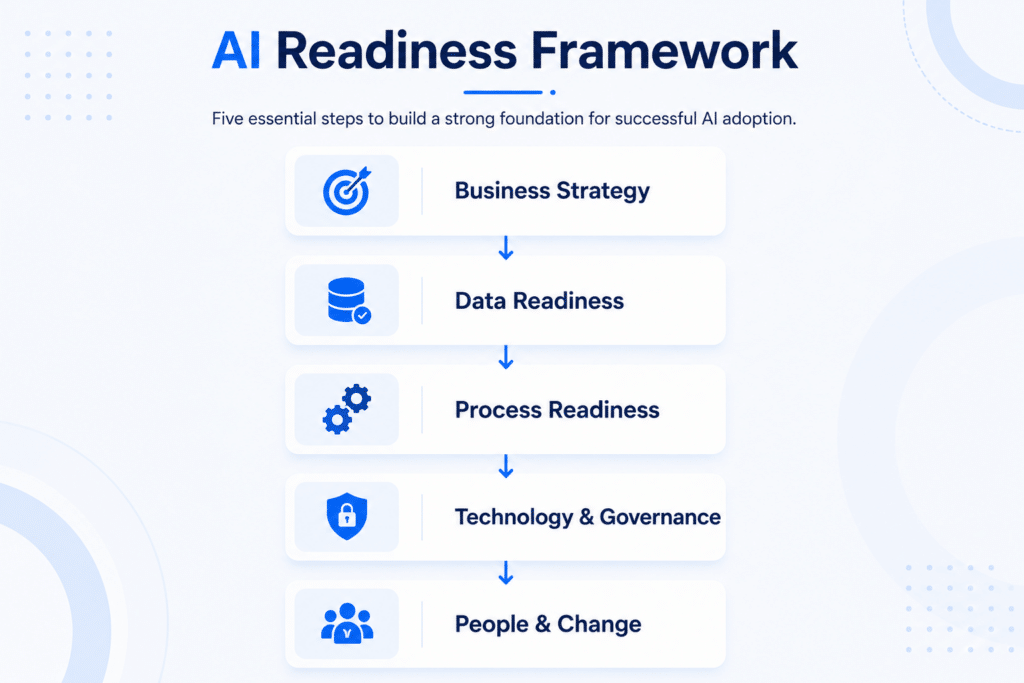
Your AI Readiness Framework infographic
Why AI Projects Fail Before They Begin
The Problem Isn't the Technology
When AI initiatives fail to deliver expected results, organizations often look for technical explanations.
- Was the wrong model selected?
- Did implementation take too long?
- Was the platform capable enough?
While these questions matter, they rarely explain why AI struggles to create lasting business value.
Research from McKinsey consistently shows that although organizations continue increasing AI investments, only a relatively small percentage have successfully scaled AI across the enterprise. The challenge is rarely a lack of technology. More often, it is the inability to integrate AI into existing business operations.
From our experience as an AI Solutions Company, the real issue often begins long before implementation. AI cannot compensate for unclear business priorities, disconnected operations, poor-quality data, or the absence of a well-defined adoption strategy.
Organizations frequently focus on deploying AI before defining how it will create measurable value. As a result, even technically successful projects struggle to deliver meaningful business outcomes.
Key Insight
AI doesn’t create business maturity. It requires business maturity.
A Real-World Business Scenario
Consider a global retail company implementing an AI-powered demand forecasting solution to improve inventory planning and reduce stock shortages.
During testing, the AI model performs exceptionally well. Historical sales data is analyzed, demand patterns are identified, and inventory recommendations appear highly accurate.
However, once deployed across multiple regions, the expected business outcomes fail to materialize.
Sales data is stored across multiple systems. Product categories differ between departments. Inventory updates are delayed. Regional teams follow different operational processes.
As a result, the AI generates inaccurate forecasts, leading to overstocking in some locations while other stores experience stock shortages.
The technology performs exactly as designed.
The business environment does not.
This example highlights an important reality:
AI rarely fails because the algorithms are ineffective. More often, it exposes weaknesses that already exist within the business.
Example: AI Forecasting API Request
While business leaders don’t need to understand code, this example illustrates how AI systems depend on accurate business data.
POST /api/v1/forecast

Content-Type: application/json

{

  "store": "LHR-102",

  "product": "Laptop",

  "salesHistory": [95,101,112,130],

  "inventory": 58

}

AI Response

{

  "forecast": 145,

  "confidence": 0.97,

  "recommendedStock": 170

}
The quality of the forecast depends entirely on the quality of the underlying data.
Even the most sophisticated AI models cannot compensate for inaccurate or incomplete information.
Preparation Drives AI Success
Many organizations focus on deploying AI before defining:
- Why they are implementing it
- How success will be measured
- Which capabilities are required to support it
- Who will be accountable for outcomes
As a result, technically successful implementations often fail to generate meaningful business impact.
Successful AI adoption is not driven by sophisticated algorithms alone.
It is driven by preparation.
Organizations that strengthen strategy, data, processes, governance, technology, and people before scaling AI reduce implementation risk.
They are also more likely to achieve measurable business outcomes.
The question is not whether an organization has access to AI.
The question is whether the business is prepared to succeed with it.
The Five Foundations of AI Readiness
1. Business Strategy: Start with the Business Problem
- The business problem being solved
- Expected outcomes
- Success metrics
- Organizational impact
AI should be viewed as an enabler of business strategy rather than the strategy itself.
Organizations that begin with clear objectives are better equipped to prioritize investments, allocate resources effectively, and measure meaningful outcomes. Without this clarity, AI initiatives often become technology experiments that generate excitement but deliver little long-term value.
Example: Retail Industry
A retailer implementing AI to improve inventory forecasting is far more likely to succeed than one adopting AI simply because competitors are doing so.
By defining a measurable objective such as reducing stock shortages by 20% or improving inventory turnover the organization can evaluate whether the initiative is delivering business value rather than simply introducing new technology.
Example: Financial Services
A financial institution may implement AI to automate document verification and risk assessment.
If the business objective is reducing loan approval times, success can be measured through:
- Faster approval cycles
- Improved customer satisfaction
- Lower operational costs
- Increased operational efficiency
This is where strategic AI Consulting plays a critical role by aligning technology initiatives with measurable business goals.
Pull Quote
Organizations shouldn’t adopt AI because it’s available. They should adopt AI because it solves a measurable business problem.
2. Data Readiness: Build Trust Before Intelligence
AI depends on reliable, accessible, and well-governed data.
When information is fragmented across departments or inconsistent across systems, AI produces inconsistent outcomes. Improving data quality is not simply preparation for AI it is a fundamental part of successful AI implementation.
Organizations often assume AI can compensate for poor-quality data.
The opposite is true.
AI learns from the information it receives. If data is incomplete, duplicated, outdated, or inaccurate, the outputs will reflect those same weaknesses.
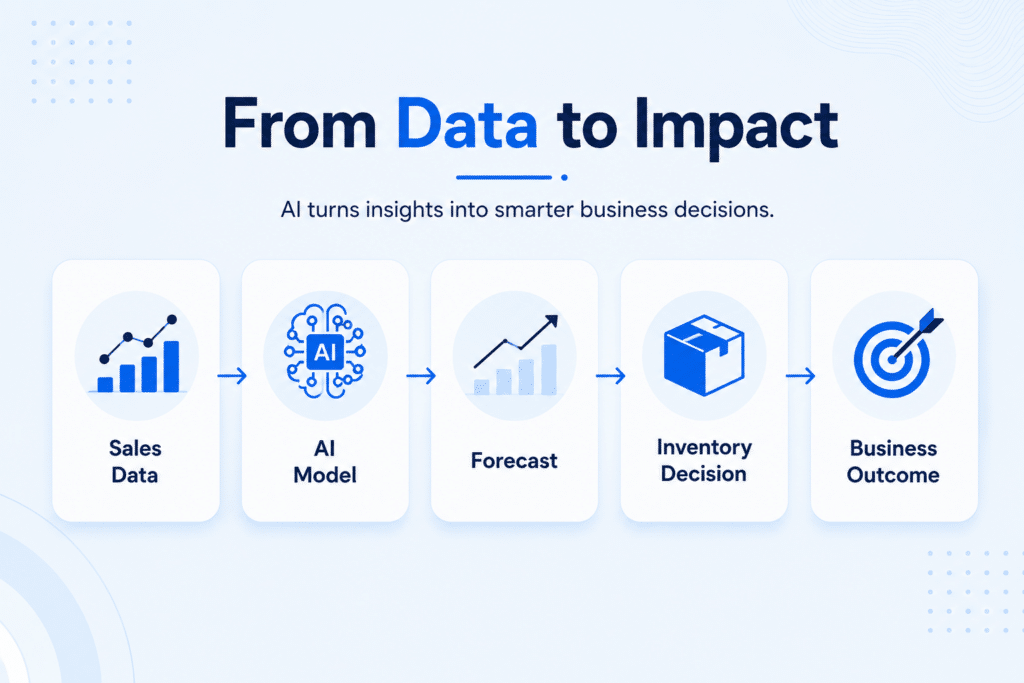
Rather than solving data problems, AI often exposes them.
This is why leading providers of Machine Learning Services, Predictive Analytics, and AI Integration Services prioritize data readiness before deploying advanced AI models.
Example: Retail Industry
A retailer implements AI to forecast customer demand across multiple locations.
The AI performs well during testing but fails after deployment because:
- Sales data exists in multiple systems
- Product categories are inconsistent
- Inventory updates are delayed
- Regional reporting standards differ
Example: Financial Services
A bank introduces AI to detect fraudulent transactions in real time.
However:
- Customer records are incomplete
- Transaction histories contain inconsistencies
- Banking systems are not fully integrated
The AI generates false alerts while missing genuine fraud cases.
By improving data quality, integrating systems, and establishing strong governance practices, the organization significantly improves the accuracy and reliability of its AI-powered fraud detection systems.
Data Readiness Comparison
Poor Data | AI-Ready Data |
Duplicate records | Clean records |
Missing values | Complete datasets |
Disconnected systems | Integrated platforms |
Inconsistent formats | Standardized data |
Manual updates | Automated pipelines |
Internal Linking Opportunities
Within this section, link naturally to:
- AI Development Company
- AI Consulting
- AI Software Development
- AI Integration Services
- Machine Learning Services
- Predictive Analytics Company
3. Process Readiness: Optimize Before You Automate
AI accelerates processes it doesn’t redesign them.
Automating inefficient workflows simply allows inefficiencies to happen faster and at greater scale. Before implementing AI, organizations should evaluate their existing processes, eliminate unnecessary steps, clarify ownership, and standardize workflows.
Whether you’re deploying an AI-powered workflow through an AI Automation Company or integrating intelligent business applications, automation should enhance an optimized process not compensate for an ineffective one.
Organizations that improve their workflows before automation are far more likely to realize measurable gains in productivity, operational efficiency, and customer experience.
Example: Finance Workflow Automation
Consider a finance department where every invoice requires approval from five different managers before payment can be processed.
To improve efficiency, the organization introduces an AI-powered approval system that automatically routes invoices, sends reminders, and prioritizes requests.
Although manual work is reduced, approvals continue to take days because the underlying workflow remains unnecessarily complex.
Instead of solving the problem, AI simply accelerates an inefficient process.
If the organization first redesigns the workflow by:
- Reducing unnecessary approval layers
- Assigning clear ownership
- Removing redundant handoffs
- Standardizing approval rules
the AI solution can automate an already efficient process, delivering faster approvals, lower administrative costs, and a better experience for employees and vendors.
Example Automation Workflow
POST /api/v1/invoice/approve

{

  "invoiceId": "INV-1025",

  "amount": 8500,

  "department": "Finance"

}
Business Insight
AI delivers the greatest value when it enhances well-designed processes not when it attempts to repair broken ones.
Ask Yourself
Are we improving an effective process, or simply automating an inefficient one?
4. Technology & Governance: Build for Scale
Technology should support business strategy not define it.
As AI initiatives expand, organizations need infrastructure that integrates seamlessly with existing systems while maintaining security, compliance, governance, and responsible AI practices.
This is where AI Integration Services become critical. Successful AI adoption depends on connecting AI with existing ERP, CRM, data platforms, and business applications while maintaining reliability, security, and scalability.
As organizations move from experimentation to enterprise-wide deployment, governance becomes just as important as technology.
According to Deloitte, organizations that establish strong governance frameworks are significantly better positioned to scale AI responsibly while reducing operational and regulatory risk.
Example: AI in Financial Services
A financial institution introduces AI to evaluate loan applications.
The AI analyzes customer information, assesses risk, and generates lending recommendations within minutes.
Without governance, however, several risks emerge:
- AI decisions become difficult to explain.
- Potential bias goes undetected.
- Compliance becomes difficult to demonstrate.
- Sensitive customer data is exposed to unnecessary risk.
By implementing:
- AI governance policies
- Encryption
- Access controls
- Model monitoring
- Regular audits
The organization creates an AI ecosystem that is secure, transparent, and compliant.
Example API Response
{

  "loanDecision": "Approved",

  "confidence": 0.94,

  "riskLevel": "Low"

}
Callout Box
Enterprise AI Requires More Than Models
Successful AI platforms combine:
- Security
- Governance
- Compliance
- Monitoring
- Scalability
Ask Yourself
Can our technology environment support AI securely, responsibly, and at enterprise scale?
5. People & Change Readiness: Make Adoption Part of the Strategy
Technology adoption is ultimately a people challenge.
Even the most advanced AI solution delivers limited value if employees don’t trust it, understand how it works, or know how to incorporate it into their daily workflows.
Whether organizations deploy a Custom AI Chatbot, Voice AI Solutions, AI Agent Development, or Generative AI Development, long-term success depends on employee adoption as much as technical capability.
Organizations that invest in communication, leadership alignment, employee training, and continuous learning are significantly more likely to achieve sustainable AI adoption.
Example: AI-Powered Customer Support
A customer support team introduces an AI assistant that recommends responses and summarizes customer conversations.
Although the assistant provides accurate suggestions, many agents ignore the recommendations because they:
- Don’t understand how AI generates responses.
- Worry about making mistakes.
- Lack confidence in the system.
As a result, response times remain unchanged.
The technology works.
Adoption does not.
The organization responds by:
- Delivering hands-on training
- Explaining how AI recommendations are generated
- Defining when human judgment should override AI
- Collecting employee feedback for continuous improvement
Over time:
- Employee confidence increases
- AI adoption improves
- Response times decrease
- Customer satisfaction rises
Business Insight
Successful AI adoption isn’t just about implementing technology. It’s about enabling people to use it with confidence.
Ask Yourself
Are our teams prepared to adopt AI with confidence, or are we only preparing the technology?
Bringing the Framework Together
These five foundations are interconnected.
- Business Strategy ensures AI solves the right problems.
- Data Readiness enables accurate and reliable insights.
- Process Readiness ensures automation improves efficiency.
- Technology & Governance provide security, scalability, and compliance.
- People & Change drive long-term adoption and business value.
Organizations that strengthen these five pillars before scaling AI significantly reduce implementation risk and increase the likelihood of measurable business outcomes.
Working with an experienced AI Development Company or leveraging AI Consulting services can accelerate this journey, but technology alone is never enough. Sustainable AI success is built on a strong business foundation supported by the right strategy, governance, and people
Common Mistakes That Delay AI Success
Why AI Initiatives Lose Momentum
Understanding AI readiness is one thing. Applying it consistently across an organization is another.
Why Execution Matters
Many organizations recognize the importance of strategy, governance, and change management, yet their AI initiatives still struggle not because the technology falls short, but because execution does.
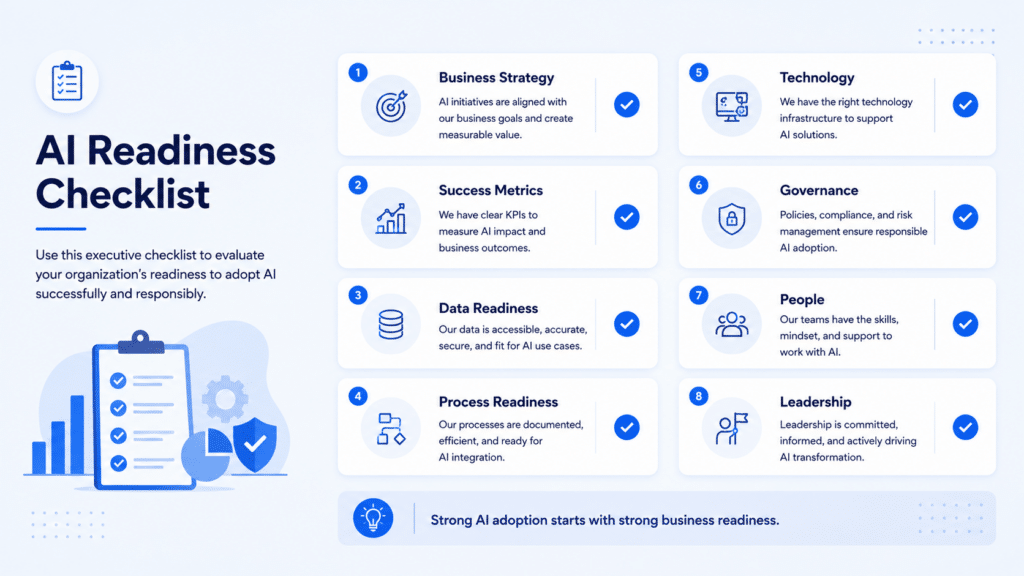
Whether an organization is investing in Generative AI Development, deploying AI Agent Development, or working with an experienced AI Consulting partner, avoiding common implementation mistakes is just as important as selecting the right technology.
Organizations that identify these challenges early are far more likely to move beyond pilot projects and achieve sustainable business outcomes.
Mistake #1 Starting with AI Instead of the Business Problem
One of the most common reasons AI initiatives fail is that organizations begin by exploring AI capabilities before defining the business challenge they want to solve.
This often results in impressive demonstrations but limited business value because the technology isn’t aligned with a measurable objective.
Example
A company deploys an AI-powered assistant across its customer service department simply because competitors are adopting similar tools.
Employees actively use the assistant, but leadership never defines whether the objective is to:
- Reduce response times
- Improve customer satisfaction
- Lower operational costs
- Increase first-contact resolution
Although adoption is high, the organization cannot demonstrate measurable business impact or justify future investment.
Key Takeaway
AI should solve business problems not become the business objective.
Mistake #2 Treating AI as a One-Time Project
AI isn’t a project with a finish line.
Business priorities evolve. Customer behavior changes. Regulations develop. Markets shift.
Successful AI initiatives require continuous monitoring, optimization, and improvement rather than a one-time implementation.
Organizations that continuously refine their AI models consistently outperform those that simply deploy and move on.
Example
A retail company introduces an AI-powered pricing engine that initially improves sales and profit margins.
Over time, customer preferences, seasonal buying patterns, and competitor pricing change.
Because the organization never retrains the model or evaluates its performance, pricing recommendations gradually become less accurate, reducing profitability and customer satisfaction.
Continuous optimization is essential to maintaining long-term business value.
Mistake #3 Scaling Before Validating
The excitement surrounding AI often encourages organizations to expand initiatives before proving measurable business value.
Scaling too early increases complexity, implementation costs, and organizational resistance while making future investment decisions more difficult.
The most successful organizations validate results before expanding AI across the enterprise.
Example
A manufacturing company successfully pilots an AI-powered predictive maintenance solution in one production facility.
Encouraged by early success, leadership rapidly deploys the solution across every factory without validating differences in equipment, maintenance procedures, and data quality.
As a result, inconsistent operating environments reduce model accuracy, increase maintenance costs, and create skepticism among operational teams.
Validating results before scaling would have significantly reduced both risk and implementation costs
Mistake #4 Measuring Technology Instead of Business Outcomes
An AI solution may achieve outstanding technical performance while delivering very little commercial value.
Business leaders don’t invest in AI because models are accurate.They invest because AI improves productivity, reduces costs, enhances customer experiences, and drives revenue growth.
Example
A company proudly reports that its AI-powered chatbot handled over 100,000 customer conversations during the first quarter after launch.
While this appears impressive, customer satisfaction remains unchanged, first-contact resolution does not improve, and support costs remain the same.
The organization measured AI activity instead of business outcomes.
A more meaningful evaluation would focus on whether the chatbot:
- Reduced resolution times
- Improved customer satisfaction
- Lowered operational costs
- Increased employee productivity
Instead of Measuring Measure
AI tools deployed | Operational efficiency |
Models in production | Business KPIs |
Chatbot interactions | Customer satisfaction |
AI users | Employee productivity |
Pilot projects | Revenue growth and cost optimization |
Business Insight
Successful AI programs aren’t measured by the sophistication of the technology. They’re measured by the business decisions they improve and the measurable outcomes they create.
Avoiding these mistakes doesn’t require more advanced AI it requires stronger business discipline.
Organizations that validate value before scaling, align AI initiatives with strategic priorities, continuously optimize their solutions, and measure business outcomes instead of technical achievements are far more likely to transform AI initiatives into sustainable competitive advantages.
Measuring AI Success Beyond the Hype
Why Measuring AI Success Matters
One of the most common reasons AI initiatives lose executive support isn’t because the technology fails.
It’s because organizations struggle to demonstrate business value.
Launching an AI solution, completing a successful pilot, or achieving high employee adoption may indicate progress, but these milestones rarely answer the question every executive eventually asks:
“What measurable impact has AI created for the business?”
According to PwC, organizations that align AI initiatives with clear business objectives are significantly more likely to realize measurable value from their AI investments.
The lesson is simple:
AI success should be measured by business outcomes not implementation milestones.
Shift the Focus from Activity to Impact
Many organizations unintentionally measure AI activity instead of AI value.
Metrics such as the number of AI tools deployed, models in production, or chatbot interactions demonstrate adoption, but they do not explain whether AI is improving business performance.
Executive teams care less about how much AI has been implemented and more about whether it is creating tangible business results.
The simplest way to make this shift is to stop measuring AI activity and start measuring business impact.
Instead of Measuring | Measure |
Number of AI tools deployed | Process efficiency and cycle time |
Models in production | Business KPIs influenced by AI |
Number of AI users | Employee productivity and time saved |
Pilot projects completed | Revenue growth and cost optimization |
Chatbot interactions | Resolution time and customer satisfaction |
Why Business KPIs Matter
Business KPIs provide a direct connection between AI investments and organizational performance.
Metrics such as:
- Revenue growth
- Operational efficiency
- Cost reduction
- Customer satisfaction
- Employee productivity
- Faster decision-making
allow leadership teams to determine whether AI is delivering measurable business value.
Without these indicators, organizations may continue investing in AI without understanding whether those investments are producing meaningful outcomes.
Example
Consider two organizations implementing AI-powered customer support assistants.
The first celebrates 100,000 chatbot conversations and 90% employee adoption.
The second reports:
- 40% faster response times
- 18% increase in customer satisfaction
- 15% reduction in support costs
- Higher first-contact resolution
Although both deployed similar AI technology, only the second organization can confidently justify additional investment because it measures business outcomes rather than implementation activity.
Executive Insight
If AI disappeared tomorrow, which business KPI would change?
If that question is difficult to answer, your AI initiative may not yet be delivering measurable business value
Reporting Value, Not Activity
Executives rarely approve future AI investment because a model is accurate or widely adopted.
They invest because AI helps the business:
- Increase revenue
- Reduce costs
- Improve customer experiences
- Accelerate decision-making
- Strengthen operational efficiency
When organizations evaluate AI through measurable business outcomes, decision-making becomes clearer.
Leaders can identify which initiatives deserve additional investment, which require refinement, and which no longer align with strategic priorities.
Ultimately, organizations don’t achieve competitive advantage because they deploy more AI than everyone else.
They achieve it because they continuously measure, optimize, and scale the AI initiatives that create meaningful, measurable business value.
AI Readiness Checklist
Frameworks provide direction. Decisions require validation.
Before expanding AI across your organization, it’s important to pause and evaluate whether the essential foundations for successful AI adoption are already in place.
This executive self-assessment isn’t designed to determine whether your organization can adopt AI. It’s designed to determine whether you’re prepared to adopt it successfully.
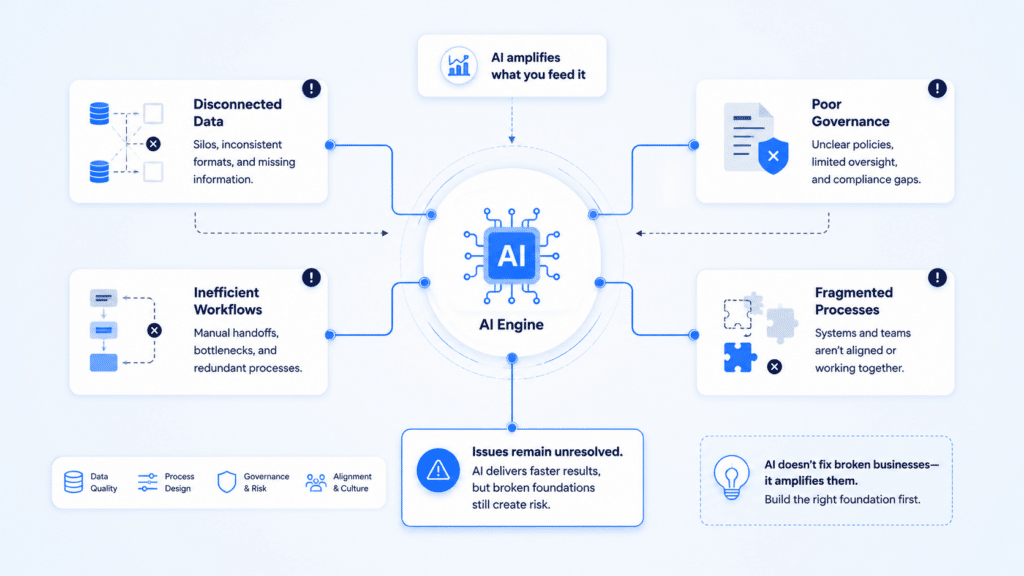
Whether you’re planning AI Software Development, investing in AI Integration Services, or exploring enterprise AI initiatives, readiness is what transforms technology investments into measurable business outcomes.
Executive AI Readiness Self-Assessment
Foundation | Executive Question |
Business Strategy | Have we clearly defined the business problem AI is expected to solve? |
Success Metrics | Have we identified the business KPIs that will determine whether this initiative succeeds? |
Data Readiness | Can we trust the quality, accessibility, and governance of the data AI will rely on? |
Process Readiness | Are we improving an effective process or simply automating an inefficient one? |
Technology | Can our existing technology environment support AI securely and at enterprise scale? |
Governance | Have we established policies for responsible AI, compliance, and risk management? |
People | Do employees understand how AI will support their work, and are they prepared to adopt it confidently? |
Leadership | Is executive leadership aligned on priorities, investment expectations, and long-term business outcomes? |
Interpreting Your Assessment
This checklist is not intended to produce a pass-or-fail result. Instead, it helps identify where additional preparation may be needed before AI initiatives are expanded.
Organizations that can confidently answer “Yes” to most of these questions typically have a stronger foundation for scaling AI successfully. Those identifying several gaps should view them as opportunities not barriers to strengthen their AI strategy.
Addressing these readiness gaps early helps reduce implementation risk, improve employee adoption, strengthen governance, and increase the likelihood of generating measurable business value.
The objective isn’t to achieve perfect readiness before taking action. It’s to ensure your organization is building AI on a foundation strong enough to support long-term success
Why the Right Technology Partner Matters
A strong AI foundation improves the likelihood of success, but it does not guarantee meaningful business impact.
The difference between experimentation and enterprise transformation often comes down to execution and that execution is shaped by the experience, capabilities, and strategic approach of the technology partner an organization chooses.
The right partner does more than implement AI solutions.
Beyond Technology Implementation
They help businesses validate strategic priorities, identify high-value opportunities, reduce implementation risks, and ensure AI initiatives remain aligned with broader business objectives.
Their role is not simply to deliver technology. It is to help organizations translate technology investments into measurable business outcomes.
Whether the initiative involves Generative AI Development, AI Agent Development, Custom AI Chatbot solutions, Voice AI Solutions, Computer Vision Development, or RAG Development, successful implementation begins with understanding the business challenge before selecting the technology.
The Difference a Strategic Partner Makes
Consider two organizations beginning similar AI transformation initiatives.
The first works with a vendor focused primarily on delivering an AI solution as quickly as possible. The technology is implemented on schedule, but little attention is given to business objectives, data quality, employee adoption, or workflow integration. While the system functions as expected, user adoption remains low, operational inefficiencies persist, and leadership struggles to demonstrate a meaningful return on investment.
The second organization takes a different approach.
Before development begins, its technology partner works closely with business leaders to define strategic goals, assess AI readiness, improve data quality, optimize business processes, establish governance standards, and prepare employees for change.
AI is introduced in phases, progress is measured against clearly defined business KPIs, and continuous improvements are made based on real-world feedback.
The result is faster adoption, stronger employee confidence, improved operational efficiency, better customer experiences, and measurable business value.
The technology may be similar in both organizations, but the outcomes are very different.
The difference lies in preparation, execution, and strategic alignment.
From Implementation to Business Transformation
As AI adoption moves beyond isolated pilot projects, organizations face new challenges that extend far beyond technology.
Scaling AI across departments, integrating solutions with existing systems, maintaining governance standards, and continuously measuring business outcomes require both technical expertise and business understanding.
An experienced AI Development Company brings these capabilities together by aligning AI initiatives with long-term organizational goals rather than short-term implementation milestones.
Ultimately, technology partners should not be evaluated by the number of AI solutions they build, but by the business value those solutions create.
Organizations that choose partners focused on measurable outcomes rather than implementation alone are better positioned to reduce risk, accelerate adoption, and achieve sustainable competitive advantage.
Conclusion
Enterprise AI adoption is not a race to implement the latest technology.
It is a strategic journey that begins with ensuring your organization has the right foundation to support AI in a way that creates lasting business value.
Throughout this guide, we’ve explored why AI initiatives fail, what true AI readiness looks like, the five foundations that enable successful adoption.
The common execution challenges that delay progress, and the metrics that define meaningful success.
The message is simple:
Organizations achieve better AI outcomes when they strengthen their strategy, data, processes, governance, technology, and people before scaling AI.
Technology alone cannot guarantee success.
Business readiness can.
Organizations that align AI initiatives with measurable objectives, invest in reliable data, optimize workflows, establish responsible governance, and prepare employees for change are far more likely to transform AI investments into sustainable competitive advantage.
AI will continue to evolve.
The organizations that benefit most won’t necessarily be those that adopt AI first they’ll be the ones that adopt it with purpose, preparation, and a clear business strategy.
- Enforce multi-factor authentication (MFA)
- Apply least-privilege permissions
- Review user access rights on a regular basis
- Remove inactive accounts and unused tokens
Successful AI isn’t defined by how quickly it’s implemented. It’s defined by how consistently it delivers measurable business value.
Ready to Assess Your AI Readiness?
Every successful AI initiative begins with a clear understanding of where your organization stands today.
Whether you’re exploring AI Consulting, planning AI Software Development, implementing AI Integration Services, or building enterprise AI solutions, investing in readiness today reduces risk and increases the likelihood of long-term success.
The Right Software helps organizations assess AI readiness, identify high-impact opportunities, and develop practical AI strategies aligned with measurable business goals.
Because successful AI isn’t just about implementing technology it’s about creating lasting business impact.