
For decades, the standard automated phone call in customer service followed a predictable, frustrating script. You spoke into a microphone, waited through a heavy, mechanical silence, and listened as a robotic voice synthesized a response from a pre-scripted tree. Even as modern artificial intelligence replaced basic interactive voice response (IVR) systems with large language models, a fundamental barrier remained: latency.
The Latency Barrier in Traditional Voice Automation
When a human speaks to another human in natural conversation, the gap between turns is remarkably brief—typically between 200 and 250 milliseconds. If a customer service agent takes more than 800 milliseconds to acknowledge a statement, the caller’s brain registers awkwardness, hesitation, or disinterest. Until recently, standard AI voice architectures operated with latencies ranging from 1,500ms to 3,500ms.
This delay creates a painful user behavior loop—the “accidental interruption” spiral:
Initial Silence: Callers wait through up to two seconds of dead air after asking a question.
Premature Repetition: Thinking the system froze, the user begins repeating the prompt.
Collision: Mid-sentence, the AI begins speaking, leading both parties to talk over one another.
The result is an awkward, turn-taking choreography where users sit in uncomfortable silence or constantly collide with the agent on the line.
Evolution of Voice Automation Latency
| Voice Architecture Era | Average Response Latency | Conversational Experience | Primary Failure Point |
| Traditional Rule-Based IVR | 3,000ms – 5,000ms+ | Mechanical, rigid menu navigation | Traps users in infinite button-press loops |
| Cascaded AI (STT + LLM + TTS) | 1,500ms – 3,500ms | Delayed, disjointed turn-taking | High latency causes constant talking over the AI |
| Sub-300ms Native Voice AI | 150ms – 300ms | Fluid, natural, human-like turn-taking | Seamless; allows real-time barge-in & interruptions |
1. Death of the Cascaded Pipeline
To understand why real-time voice AI feels fundamentally different today, we must first look at the traditional setup that dominated contact centers for years: the cascaded pipeline.
┌─────────────────────────────────────────────────────────────────────────┐
│                    TRADITIONAL CASCADED PIPELINE                         │
│                                                                         │
│  [ Caller Speech ] ──> (1) STT Model ──> [ Text Transcript ]           │
│                                                   │                     │
│                                                   ▼                     │
│  [ Audio Response ] <── (3) TTS Model <── [ Text Response ] <── (2) LLM │
└─────────────────────────────────────────────────────────────────────────┘
In a traditional cascaded system, a customer’s voice call passes through three isolated software layers operating sequentially:
- Speech-to-Text (STT): An automatic speech recognition engine transcribes incoming audio into a text string.
- Large Language Model (LLM): The text transcript is fed into an LLM (such as GPT-4 or Claude), which processes the context, searches knowledge bases via retrieval-augmented generation (RAG), and generates a text response.
- Text-to-Speech (TTS): Generated text response is sent to a neural voice synthesizer (such as ElevenLabs, Cartesia, or Azure TTS) to generate spoken audio.
Why Cascaded Systems Suffer from High Latency
While cascaded pipelines allow developers to swap components easily, they suffer from severe cumulative delays:
Serialization & Network Hops: Each model boundary requires network transport, serialization, and deserialization. Incoming audio travels from the caller’s device over WebRTC or SIP to an STT service, converts to text, jumps over HTTP to an LLM provider, routes to a TTS synthesis server, and finally streams back to the caller.
Endpointing Latency: Before finalizing a transcript, speech recognition engines must wait for the caller to finish speaking—a detection buffer that alone often adds 300ms to 700ms.
Text Generation Overhead: Speech synthesis cannot produce natural audio until the LLM generates several initial tokens.
Even with edge streaming, fast models, and optimized socket connections, cascaded architectures struggle to consistently break through the sub-1,000ms barrier in complex, real-world enterprise environments.
Emotional Gap: Flattened Metadata
A biggest downside of cascaded pipelines isn’t just speed—it’s information loss.
When STT transcribes spoken words into text, it strips away all acoustic metadata. The words “Great, my order is delayed again” look identical to an LLM whether spoken with genuine satisfaction, dry sarcasm, or extreme anger. Because the reasoning model receives only flattened text, it cannot hear tone, pitch, cadence, volume, or background noise. The resulting system responds with equal emotional flatness, missing critical conversational cues that human agents use naturally.
2. Native Speech Models: Direct Audio-to-Audio Reasoning
Shift toward native speech-to-speech models (such as GPT-4o Realtime, Gemini Live, and emerging open-weights models) completely changes this dynamic.
┌─────────────────────────────────────────────────────────────────────────┐
│                      NATIVE SPEECH-TO-SPEECH                            │
│                                                                         │
│  [ Audio Tokens In ] ──────> [ Unified Model ] ──────> [ Audio Out ]    │
│   (Pitch, Cadence, Tone)      (Single Pass)          (Expressive Voice) │
└─────────────────────────────────────────────────────────────────────────┘
A native speech model does not transcribe speech into text before reasoning. Instead, it tokenizes raw audio waveforms directly into multimodal audio tokens. The transformer core processes these audio tokens natively and outputs synthetic audio tokens directly—all within a single forward pass.
Key Benefits of Native Speech-to-Speech
| Capability | Cascaded Architecture (STT + LLM + TTS) | Native Speech-to-Speech Model |
| Median End-to-End Latency | 1,200ms – 3,000ms | 150ms – 300ms |
| Tone & Sentiment Perception | Text sentiment only (strips vocal tone) | Direct acoustic perception (understands pitch, sarcasm, distress) |
| Output Expressiveness | Synthetic prosody based on punctuation | Dynamic prosody, whisper, hesitation, laughing, pitch adjustment |
| Interruption (Barge-In) | Complex external audio ducking required | Native streaming duplex; stops instantly when user interrupts |
| Component Flexibility | High (can swap STT, LLM, or TTS independently) | Tied to model provider capabilities |
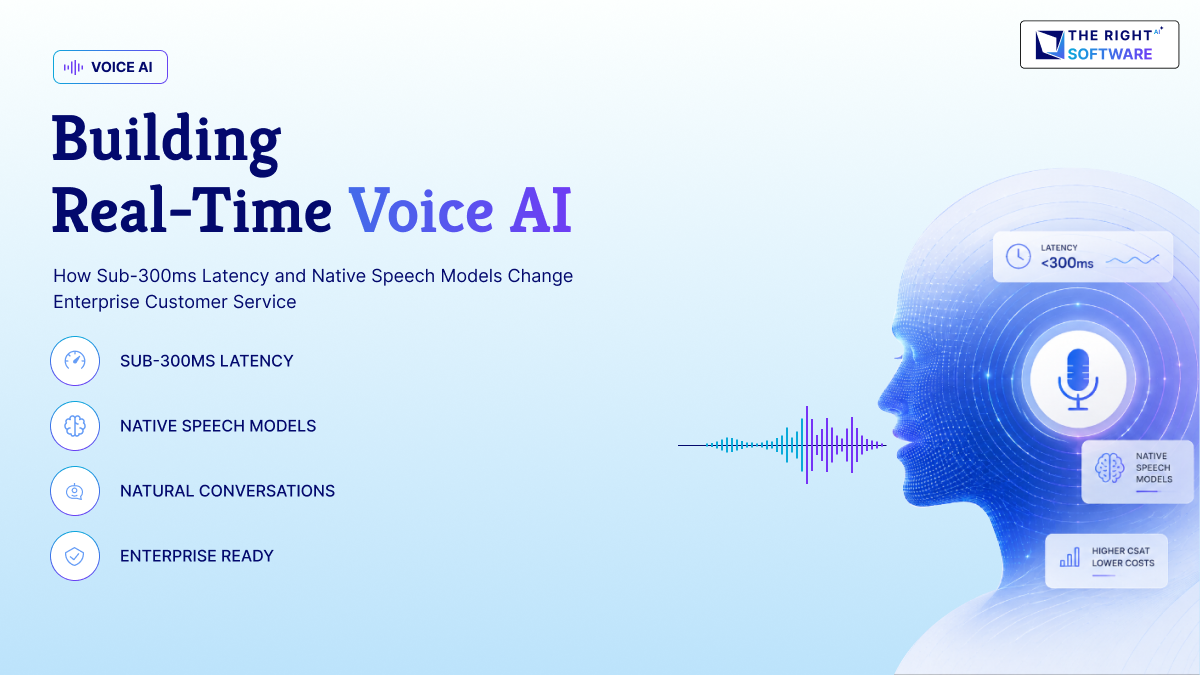
By eliminating intermediate model hand-offs, native speech models break through the latency wall and bring real-time processing well under 300 milliseconds.
3. The Psychology of Sub-300ms Latency in Customer Service
Why is the 300-millisecond threshold such a major benchmark for enterprise contact centers?
Human speech processing is deeply tied to social cues. In human conversation, turn-taking is controlled by micro-cues: trailing vocal pitch, breath pauses, and subtle changes in tempo. In natural conversation, human brains actively anticipate turn completion and prepare responses in real time.
0ms               150ms             300ms             600ms            1000ms+
├─────────────────┼─────────────────┼─────────────────┼────────────────┤
│ Subconscious    │ Human Conversational            │ Uncanny Valley │ Awkward Silence
│ Instant Rebound │ Turn-Taking Threshold           │ Cognitive Strain│ Interruption Overlap
When an enterprise AI agent operates across different latency windows, the customer experience changes dramatically:
Above 1,000ms Latency: Customer experiences cognitive friction. They wonder if the line went dead, repeat themselves, or speak over the agent just as it begins answering. This creates accidental interruptions and doubles average handle time (AHT).
500ms to 800ms Latency: Interaction works for transactional tasks, but feels unmistakably robotic. The caller subconsciously adapts by using simple, artificial phrases rather than speaking naturally.
Sub-300ms Latency: AI enters the natural human conversational threshold. Pauses feel intentional rather than mechanical. The caller drops their “talking to a machine” voice and engages in a fluid, natural conversation.
Real-Time Barge-In and Full-Duplex Interactions
In traditional phone support, if a bot starts reading a long list of options and the caller interrupts with “No, I meant my shipping address, not my billing address!“, the system often fails to react. It continues reading its script until the audio buffer finishes, frustrating the caller.
Sub-300ms native speech architectures enable full-duplex communication. The model listens continuously while speaking. The moment the caller speaks, the model registers the incoming audio tokens, cuts off its own audio stream within milliseconds, adjusts its reasoning, and responds to the interruption gracefully. This capability alone transforms difficult customer support interactions into pleasant, human-like conversations.
4. Transforming Enterprise CX: Real-World Business Scenarios
Sub-300ms voice AI goes far beyond basic phone trees. It unlocks high-stakes, fast-paced enterprise customer support workflows that were previously impossible to automate cleanly.
ENTERPRISE VOICE AI USE CASES
                                ─────────────────────────────
         ┌──────────────────────────────┼──────────────────────────────┐
         ▼                              ▼                              ▼
  [ Emergency & Triage ]       [ Complex Escalations ]        [ High-Volume Operations ]
  • Flight cancellations       • Disputed charges             • Appointment scheduling
  • Healthcare intake          • Account lockouts             • Order tracking & returns
  • Immediate reassurance      • De-escalation prosody        • Fraud verification
1. High-Stress Emergency Services & Financial Fraud
Consider a customer calling their bank after noticing unauthorized charges on their credit card while standing at a checkout counter.
Traditional Experience: A customer navigates three menu tiers, spends 45 seconds explaining the problem, waits through 3-second silences after every statement, and grows increasingly anxious.
Sub-300ms Native Voice Experience: Voice agent answers on the first ring. Hearing panic and urgency in the caller’s voice, the native speech model automatically matches the moment with a calm, reassured tone. The caller can speak quickly, interrupt, and provide context without waiting for artificial pauses. The agent verifies identity, freezes the compromised card, and issues a virtual replacement within 90 seconds.
2. Complex Travel and Airline Operations During Disruptions
When winter storms cancel hundreds of flights, airline call centers face massive surge traffic. Traditional IVRs collapse, leading to hold times that stretch into hours.
With sub-300ms voice agents capable of handling 10,000+ concurrent calls, every customer gets an instant response. A customer stranded at an airport terminal can talk through alternate flights, ask about layover times, and explore baggage transfers in a natural, fluid conversation. The agent checks flight availability in real time, completes rebooking requests via backend APIs, and emails boarding passes—resolving calls in under two minutes without requiring a human agent.
3. Accessibility & Inclusive CX: Solving the Telecommunications Relay Service (TRS)
For enterprises serving diverse customer bases, compliance with Telecommunications Relay Services (TRS)—including Speech-to-Speech (STS) relay and captioned telephony—is both a regulatory obligation and a core customer experience pillar.
Traditional automated voice systems perform notoriously poorly when handling TRS calls. Standard engines frequently mistake the mandatory pauses required for human relay operators or assistive speech devices for abandoned calls, prematurely hanging up. Furthermore, cascaded Speech-to-Text engines often fail when processing synthesized speech from assistive devices or atypical vocal cadences, driving callers into frustrating error loops.
Sub-300ms native speech models fundamentally solve the TRS challenge. Because native audio models evaluate acoustic context continuously rather than relying on rigid silence timeouts, they dynamically adapt to non-standard conversational rhythms.
Real-World Scenario:
A customer with a severe speech disability calls their insurance provider using an FCC-regulated Speech-to-Speech (STS) relay operator.
Legacy IVR: Detecting a 4-second pause during operator relay, legacy systems assume the line is dead and disconnect the caller.
With Enterprise Voice AI: By recognizing the natural cadence of an STS relay transaction in real time, native voice agents maintain an open session without timing out. It holds the session state open without timing out, processes complex policy inquiry requests smoothly, and responds with dynamic pacing that gives the relay operator clear time to interpret—enabling First Call Resolution without manual human agent escalation.
5. Architectural Deep-Dive: Enterprise Orchestration at Sub-300ms
Deploying low-latency voice AI across enterprise systems requires careful engineering. Achieving sub-300ms response times while executing backend enterprise functions (such as CRM lookups or database updates) demands an optimized infrastructure stack.
┌─────────────────────────────────────────────────────────────────────────┐
│                      REAL-TIME VOICE AI ARCHITECTURE                    │
│                                                                         │
│ [ Telephony / WebRTC ] <──WebSockets──> [ Edge Media Router ]          │
│                                                 │                       │
│                                 ┌───────────────┴───────────────┐       │
│                                 ▼                               ▼       │
│                      [ Native S2S Engine ]     [ Parallel Tool Engine ] │
│                      (Sub-200ms Neural Stream) (CRM / Vector DB / API)  │
└─────────────────────────────────────────────────────────────────────────┘
1. Telephony and Media Transport (WebRTC & SIP Streaming)
Traditional PSTN phone calls use telephony protocols that introduce transport latency. Modern Voice AI platforms run on ultra-low-latency media channels:
WebRTC: Used for web and mobile app embedded calling, providing sub-50ms audio transport over UDP.
SIP Trunking with WebSocket Streaming: Connects enterprise phone lines (Twilio, Bandwidth, Genesys, Avaya) directly to AI processing nodes via bidirectionally streamed audio chunks (20ms to 50ms frames).
2. Overcoming the Tool Calling Latency Barrier
A common challenge in production voice AI is tool execution delay. If an AI voice model has to pause to search a vector database or execute a REST API call to fetch account details, the system risks breaking its 300ms latency budget.
Leading architectures use parallel execution and background speculative tool calling to maintain fluid conversation flow:
User says: "Can you change my shipping address on order #8942?"
 ├─ Native Voice Agent (Sub-100ms): "I can help with that." (Generates filler audio immediately)
 └─ Background Tool Exec (Parallel 150ms): Fetches order #8942 details from ERP database.
By generating natural transition phrases (“Let me look up that order for you right now…”) while executing database lookups in parallel, the voice agent masks backend processing latency. The caller perceives a seamless, uninterrupted conversation.
3. Solving the Enterprise Compliance & Observability Challenge
While native speech-to-speech models offer incredible speed and expressiveness, they introduce a significant challenge for enterprises: the loss of an easily inspectable text transcript in the core model loop.
Cascaded setups allow developers to log, inspect, and filter plain-text transcripts before they reach the language model or customer. Native audio-to-audio models, by contrast, process information entirely across raw audio tokens.
To deploy native voice AI safely in regulated industries (such as healthcare, banking, and insurance), enterprise architectures add asynchronous sidecar monitoring loops:
┌──────────────────────────────────────────────────────────────────────────┐
│                    ENTERPRISE REGULATORY & QA PIPELINE                   │
│                                                                          │
│ Main Audio Path:  [ User ] <──── Ultra-Low Latency S2S ────> [ AI Agent ] │
│                                         │                                │
│ Asynchronous Path:                      ▼                                │
│                            [ Real-Time STT Sidecar ]                     │
│                                         │                                │
│                                         ▼                                │
│                     [ PII Redaction & Compliance Engine ]                │
│                                         │                                │
│                                         ▼                                │
│                      [ CRM / Audit Trail / QA Dashboard ]                │
└──────────────────────────────────────────────────────────────────────────┘
Parallel STT Sidecar: An asynchronous speech recognition worker taps into the raw audio stream to create a text transcript for auditing without adding delay to the primary voice conversation path.
PII Masking & Guardrails: Sensitive data (credit card numbers, social security digits) is redacted from logs in real time.
Structured Tool Contracts: The model uses strict JSON schema definitions for tool calls, keeping database updates deterministic even when the spoken output remains fluid.
6. Business ROI: Moving from Deflection to First Call Resolution
For years, enterprise customer service teams treated automated voice systems primarily as deflection tools—mechanisms designed to push callers away from human agents to save costs, often at the expense of customer satisfaction.
Sub-300ms voice AI shifts the primary metric from call deflection to First Call Resolution (FCR).
TRADITIONAL IVR vs. SUB-300ms VOICE AI
                     ───────────────────────────────────────

   Metric                      Traditional IVR            Sub-300ms Native Voice AI
   ────────────────────────────────────────────────────────────────────────────────
   Task Completion Rate        35% - 50%                  85% - 95%+
   Average Handle Time (AHT)   4.5 minutes                1.8 minutes
   Customer Satisfaction (CSAT) 2.2 / 5.0                 4.6 / 5.0
   Cost Per Resolved Call      $5.00 - $12.00 (Human)     $0.10 - $0.35
   Concurrent Call Capacity    Limited by Agent Count     Infinite Elastic Scaling
Key Business Metrics Transformed by Real-Time Voice AI
Slashing Average Handle Time (AHT): High-latency systems drag calls out because customers must repeat themselves, clarify misheard text, and wait through artificial pauses. Sub-300ms interactions drop total call durations by 40% to 60% while resolving the underlying issue more completely.
True 24/7 Scalability without Queueing: During sudden traffic surges (e.g., product recalls, network outages, weather disruptions), traditional contact centers experience massive queue drop-offs and ballooning costs. Native voice platforms handle thousands of simultaneous calls instantly, maintaining consistent SLAs.
Redefining Cost Structures: Human phone support costs anywhere from $15 to $30 per hour ($3 to $8 per resolved call). A fully optimized, real-time voice AI agent operating on native speech infrastructure handles complete, multi-step customer interactions for a fraction of that cost, allowing human teams to focus on high-touch, empathetic relationship building.
7. Implementation Blueprint: How to Build and Deploy Enterprise Voice AI
Transitioning your enterprise customer service operations to low-latency voice AI requires a disciplined, phased approach. Here is an implementation framework derived from real-world enterprise deployments.
Phase 1: Architecture    Phase 2: Integration     Phase 3: Pilot & Testing   Phase 4: Scale
 ┌──────────────────────┐ ┌──────────────────────┐ ┌────────────────────────┐ ┌───────────────┐
 │ • Select Transport   │ │ • API Connectors     │ │ • Shadow Audio Testing │ │ • Full Rollout│
 │   (WebRTC / SIP)     │ │   (CRM / ERP)        │ │ • Human Handoff Routing│ │ • Real-Time QA│
 │ • Choose S2S Model   │ │ • Knowledge Base RAG │ │ • Safety Guardrails    │ │   Auditing    │
 └──────────────────────┘ └──────────────────────┘ └────────────────────────┘ └────────────
Phase 1: Infrastructure and Transport Selection
Choose low-latency transport links (WebRTC for web applications; direct SIP trunking for telephone lines).
Decide between a Native S2S model (for maximum conversational fluidness and emotional intelligence) and an Optimized Cascaded Pipeline (for cases requiring strict plain-text control at every step).
Phase 2: CRM and Knowledge System Integration
Expose core enterprise logic via lightweight, fast REST or gRPC microservices.
Index knowledge bases using vector embeddings optimized for short retrieval windows (<100ms vector search latency).
Implement pre-fetching algorithms so caller profile data loads instantly as the call connects.
Phase 3: Conversational Guardrails & Human Handoff
Configure clear fallback triggers. If sentiment scores dip or the agent encounters an edge case, the system performs a warm transfer to a human agent.
Pass the real-time transcript and intent summary directly to the human agent’s desktop, ensuring the customer never has to repeat themselves.
Phase 4: Continuous Automated Quality Assurance
Set up automated QA systems to evaluate 100% of calls for sentiment, task completion, and compliance.
Use real-time audio analytics dashboards to track key performance indicators such as latency, barge-in frequency, and escalation triggers.
8. Looking Ahead: The Future of Voice as the Primary Interface
We are entering a new era of enterprise technology where voice is no longer a secondary backup channel—it is becoming the primary interface for customer interactions.
As native speech models continue to evolve, we will see several exciting developments:
Real-Time Multilingual Translation: Agents that converse fluently across dozens of languages, translating regional dialects instantly while retaining the caller’s unique vocal identity.
Voice Biometrics & Instant Authentication: Secure, frictionless identity verification based on vocal characteristics, eliminating the need for security questions or passwords.
Proactive Voice Intelligence: Systems that anticipate customer needs based on recent digital activity, resolving issues before the customer even finishes describing them.
Sub-300ms latency and native speech architectures have permanently raised the bar for enterprise customer service. By closing the speed gap and unlocking true emotional intelligence, real-time voice AI transforms contact centers from frustrating operational bottlenecks into powerful drivers of customer loyalty and long-term business value.
Ready to Modernize Your Enterprise Voice Operations?
Building enterprise-grade voice AI agents requires deep expertise in low-latency infrastructure, telephony integration, and real-time model orchestration. Whether you want to automate inbound support, streamline outbound qualification, or upgrade legacy IVR systems, our team builds production-ready Voice AI solutions tailored to your infrastructure.
Explore Our Voice AI Services or Schedule a Live Latency Demo to see how sub-300ms voice agents can transform your customer service experience today.