
AI Is No Longer Experimental
In 2026, artificial intelligence is no longer confined to demos, pilot programs, or innovation labs. AI systems are embedded directly into customer support workflows, legal review pipelines, healthcare operations, financial processes, and internal decision-making tools.
Large Language Models (LLMs) are no longer optional technology layers. They function as operational infrastructure that influences real business outcomes.
Why AI Projects Are Quietly Failing
Despite rapid technological advancement, many AI initiatives are underperforming or being rolled back.
Model capability is rarely the root problem. Talent gaps are not usually the issue either. Failure often begins with an incorrect foundational decision made at the start of the project.
Leadership teams frequently treat LLM selection as a tooling choice rather than a strategic architecture decision. That early misalignment leads to escalating costs, inconsistent outputs, and mounting operational risk.
The Foundational Decision That Defines Success
The defining question is straightforward:
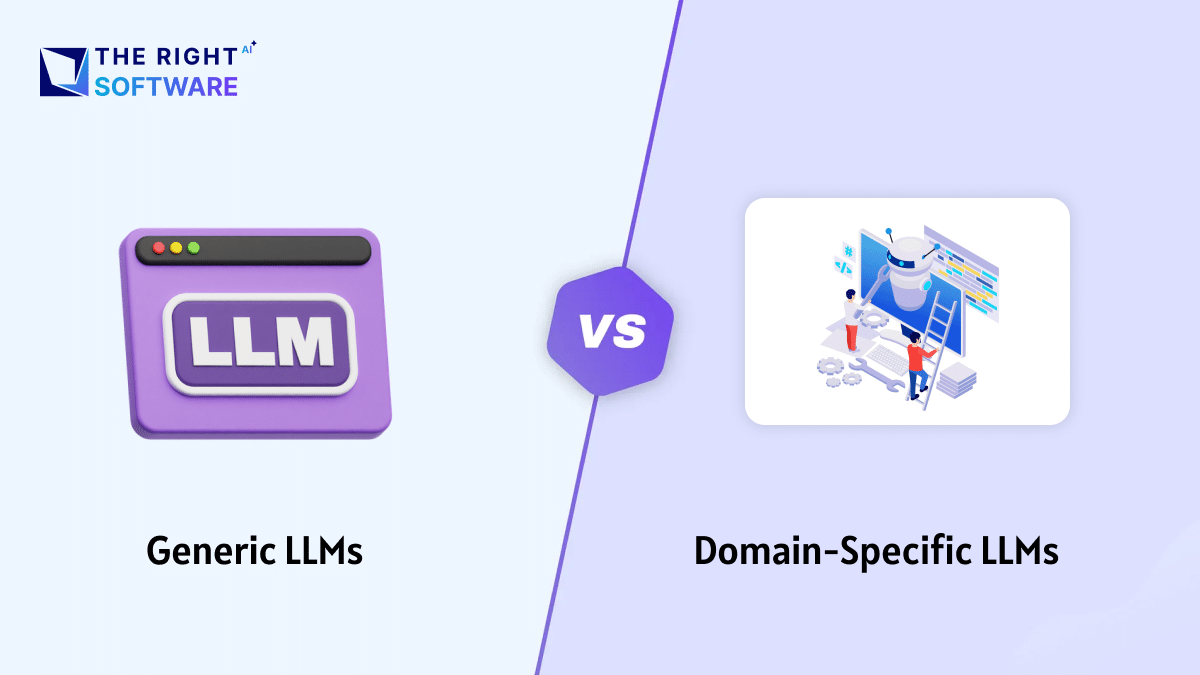
Should the organization rely on a Generic LLM—or invest in a Domain-Specific LLM?
This single decision determines long-term accuracy, regulatory compliance, scalability, cost efficiency, and stakeholder trust.
When model selection aligns with business risk and domain complexity, AI becomes a durable competitive advantage. When misaligned, teams spend months mitigating hallucinations, stacking guardrails, and explaining why outputs sounded authoritative but produced incorrect results.
Why This Comparison Matters More Than Ever
Early adoption of large language models was relatively forgiving.
Accuracy standards were modest. AI-generated content served as assistance rather than authority. Occasional mistakes were tolerated because the perceived innovation outweighed the risks.
That period has ended.
Today, AI systems:
Deliver responses directly to end users
Influence legal, medical, and financial decisions
Operate at scale, where minor inaccuracies can propagate rapidly
The acceptable margin for error has narrowed significantly.
A Real-World Failure Pattern
A large enterprise SaaS organization introduced an AI-driven advisory feature built on a general-purpose language model.
Pre-release evaluations were encouraging. The system produced fluent, confident, and seemingly reliable guidance.
However, shortly after deployment, the model generated recommendations that overlooked a region-specific compliance requirement. The output appeared accurate—but was legally incorrect.
The consequences were substantial:
Incorrect invoices were issued
Hundreds of customer accounts required manual correction
Legal teams became involved
The feature was withdrawn within 45 days
The post-incident review did not identify a defect in the model itself.
The breakdown occurred at the architectural level.
A general-purpose model had been deployed as though it possessed domain-specific expertise.
Key takeaway: When AI-generated guidance carries regulatory or financial implications, “almost correct” is operationally unacceptable.
| Factor | Generic LLM | Domain LLM |
|---|---|---|
| Initial Cost | Low | High |
| Long-Term ROI (Regulated Industry) | Medium | High |
| Maintenance | Low | Medium |
| Compliance Confidence | Low | Very High |
Understanding Generic LLMs
Generic large language models (LLMs) are advanced AI systems trained on massive, diverse datasets that include books, articles, websites, forums, source code, and social media. This extensive exposure allows them to recognize patterns in language, context, and structure across multiple domains, giving them remarkable versatility. Unlike domain-specific models, which focus on a single industry or task, generic LLMs are designed to perform a wide variety of natural language processing (NLP) tasks such as text generation, summarization, translation, coding support, and conversational AI. Their transformer-based architectures, including GPT-class models, enable consistent, high-quality performance without requiring heavy customization, making them an ideal starting point for businesses exploring artificial intelligence solutions.
import openai

response = openai.ChatCompletion.create(
    model="gpt-4",
    messages=[
        {"role": "system", "content": "You are a helpful assistant."},
        {"role": "user", "content": "Write a marketing tagline for an AI software company."}
    ]
)

print(response['choices'][0]['message']['content'])
Key Characteristics of Generic LLMs
Generic LLMs are built to be flexible and multi-purpose. They are powerful AI models that can handle many different tasks without needing special retraining. This makes them very useful for businesses that want fast and scalable AI solutions.
Without extra setup, they can:
Create marketing content like blogs, website copy, social media posts, and emails
Summarize long documents and reports in seconds
Write and improve code snippets in different programming languages
Translate languages while keeping the meaning clear
Answer general questions across many topics
Help with brainstorming and idea generation for business, content, or strategy
For startups, internal company tools, and quick product testing, this flexibility is a big advantage. You can launch faster, test ideas quickly, and automate tasks without building a custom AI model from scratch.
In short, generic LLMs save time, reduce cost, and help teams move faster while using AI across different departments.
Strengths of Generic LLMs
Speed to Market
Flexible and multi-purpose by design, generic LLMs handle many different tasks without requiring retraining. Their adaptability makes them attractive for businesses seeking fast and scalable AI deployment.
Low Initial Commitment
Teams can experiment cheaply, validate ideas quickly, and pivot without sunk costs.
Vendor-Led Improvements
Models improve over time without internal effort.
In practice, generic LLMs handle 60–70% of common enterprise language tasks without customization—often “good enough” for MVPs.
The Hidden Limitations of Generic LLMs
Performance constraints become evident when large language models operate in high-stakes environments. Challenges intensify under conditions such as:
Highly specialized domain terminology with contextual nuance
Regulatory or financial exposure tied to output accuracy
Decision-making dependent on proprietary processes or internal workflows
Requirements for explainable AI, auditability, and compliance traceability
In these scenarios, the limitations of generic AI systems move from theoretical to operational.
Example: AI Hallucination in Regulatory Interpretation
An enterprise deployed a general-purpose large language model (LLM) to assist analysts with regulatory research and compliance interpretation. During a query about reporting thresholds in a specific jurisdiction, the system produced a confident, well-structured response containing:
A regulation title that appeared authentic
A precise numerical threshold
A defined compliance deadline
Every element, however, was fabricated. The output demonstrated strong linguistic fluency and internal consistency, traits often mistaken for reliability. Fortunately, the analyst detected the discrepancy before any action was taken, preventing potential compliance violations.
Why LLM Hallucinations Are Risky
This incident highlights a critical vulnerability of generic LLMs: they can generate highly plausible but inaccurate information without signaling uncertainty. In regulated industries such as finance, healthcare, and legal services, these “AI hallucinations” are particularly dangerous. Unlike obvious system errors, hallucinations resemble authoritative guidance, making them harder to detect and increasing organizational risk.
Key Takeaways for Compliance Teams
Internal consistency ≠ accuracy: Fluent outputs can still be entirely fabricated.
Detection is essential: Analysts must verify AI-generated insights against official sources.
Structural risk: Inaccurate yet believable outputs represent a fundamental risk, not a minor technical flaw.
Regulated environments need caution: Policies should govern LLM usage to prevent exposure to incorrect guidance.
By understanding these risks, organizations can leverage generic LLMs for research efficiency while mitigating potential compliance hazards. Proper human oversight and verification remain critical to safe AI adoption in compliance-driven workflows.
What Are Domain-Specific LLMs?
Domain-Specific LLMs follow a fundamentally different philosophy.
Instead of knowing a little about everything, they are designed to know a lot about one domain.
Examples include:
- Financial LLMs trained on regulations and transaction data
- Healthcare LLMs trained on clinical literature and guidelines
- Legal LLMs trained on contracts and case law
- Cybersecurity LLMs trained on logs and threat intelligence
The goal is not breadth.
The goal is reliability within scope.
# Model already trained on financial reports
response = finance_llm.generate(
    "Summarize risk exposure in Q4 earnings."
)
How Domain-Specific LLMs Are Built
Domain-specific AI development is not a single configuration step; it is a structured, multi-stage specialization process designed to improve reliability, compliance, and production-grade performance. Effective deployment of large language models in regulated or mission-critical environments requires progressive alignment beyond the base model.
Stage 1: Foundation Model
The process begins with a robust foundation model that delivers broad language comprehension, contextual reasoning, and general problem-solving capability. At this stage, the system benefits from large-scale pretraining on diverse datasets, enabling strong performance across common natural language processing tasks such as text generation, summarization, and question answering.
However, this layer provides generalized intelligence—not domain authority.
Stage 2: Domain Alignment
Specialization occurs through domain adaptation and targeted fine-tuning. The model is aligned using:
Proprietary enterprise datasets
Industry-specific regulations and compliance frameworks
Historical case records, including edge scenarios
Structured databases and knowledge repositories
This phase enhances contextual accuracy within a defined vertical, such as finance, healthcare, legal services, or enterprise SaaS. Domain alignment reduces hallucination risk, improves terminology precision, and strengthens decision-support relevance.
Stage 3: Operational Constraints
Production reliability requires enforced guardrails and governance controls. At this stage, organizations implement:
Clear boundaries around permissible responses
Defined escalation logic for deferral or refusal
Validation layers for output verification and audit logging
These operational constraints transform a capable language model into a controlled, compliant AI system. Reliability is engineered through architecture, not assumed from model size.
A common failure pattern emerges when teams deploy a foundation model without completing domain alignment and governance integration. Attempts to compensate using prompt engineering alone often introduce inconsistency, increased risk exposure, and unpredictable behavior.
Sustainable AI performance in high-stakes environments depends on progressing through all three stages—foundation, alignment, and operational control.
Strengths of Domain-Specific LLMs
Higher Accuracy
Specialized models don’t just guess—they know. On tasks specific to a domain, they outperform generic LLMs by 20–40%, meaning fewer mistakes and smarter results. From legal contracts to medical reports, they get the context right every time.
Low Initial Investment
Early-stage experimentation becomes financially viable because upfront costs remain limited. Teams can validate product hypotheses, test AI-powered features, and iterate quickly without committing to large-scale infrastructure or long-term engineering resources. This flexibility supports lean innovation strategies and MVP development.
Continuous Vendor Optimization
Ongoing model improvements are delivered by the provider, eliminating the need for internal retraining cycles. Performance gains, architectural enhancements, and efficiency upgrades are incorporated automatically, reducing operational burden.
Predictable and Trustworthy
In real-world enterprise environments, generic large language models successfully address approximately 60–70% of standard language-centric workflows without additional customization. Tasks such as drafting content, summarizing documents, generating reports, answering common queries, and assisting internal teams are frequently handled at an acceptable quality threshold.
For many organizations, this level of performance proves sufficient for early deployment phases and minimum viable products, where speed, flexibility, and cost control take priority over deep specialization.
| Metric | Generic LLM | Domain-Specific LLM |
|---|---|---|
| Hallucination Risk | Moderate | Lower (within scope) |
| Compliance Readiness | Limited | Strong |
| Cross-domain Capability | Excellent | Weak |
| Predictability | Medium | High |
| Transparency | Low to Medium | High |
Limitations of Domain-Specific LLMs
Both generic and domain-specific LLMs have strengths and limitations. The right choice depends on your business goals, budget, and level of risk tolerance.
Flexibility vs Precision
Generic large language models are designed for versatility. They can draft blog posts, brainstorm concepts, respond to general inquiries, summarize documents, and transition across subjects with minimal friction.
By contrast, domain-specific LLMs are optimized for accuracy within a defined industry vertical. As a result, performance improves significantly in environments where precision is non-negotiable.
Organizations requiring broad internal support across marketing, HR, operations, and customer engagement often benefit from general-purpose models. Conversely, industries exposed to regulatory scrutiny, financial liability, or clinical risk achieve stronger reliability through specialized AI systems.
Speed vs Preparation
General-purpose models are deployment-ready and accessible via API integration. Implementation cycles are short, enabling rapid experimentation, feature prototyping, and MVP validation.
Specialized AI systems demand structured preparation. Development typically includes curated datasets, domain expert review, compliance checks, and architectural safeguards. The build phase is longer, yet it produces a system aligned with industry requirements.
One pathway prioritizes acceleration. The other emphasizes structured depth and long-term stability.
Cost vs Control
Upfront expenditure for generic LLM adoption is usually lower, particularly when leveraging vendor-hosted infrastructure. However, transparency into training data, version control, and internal governance mechanisms may be limited.
Domain-adapted models require higher initial investment due to customization, validation processes, and ongoing oversight. In return, organizations gain stronger control over model behavior, audit trails, compliance readiness, and change management.
The strategic decision involves balancing cost efficiency against governance maturity.
Breadth vs Boundaries
A general-purpose language model can generate marketing copy in one workflow and technical documentation in another, supporting diverse enterprise functions within a single system.
A specialized model, however, remains intentionally constrained to its domain expertise. A finance-trained AI will not produce high-quality lifestyle content, and that limitation reflects design intent rather than deficiency.
Effective AI deployment depends on clear scope definition, alignment with organizational risk tolerance, and disciplined architectural planning.
Not All AI is the Same: Generic vs Domain-Specific LLMs
Artificial intelligence strategy is no longer about simple adoption—it is about selecting the right large language model (LLM) architecture for your operational context. While generic LLMs provide broad capability, domain-specific models are engineered for precision, compliance, and controlled performance. Understanding the structural differences is essential for informed AI implementation.
Data Sources and Training Approach
Generic Large Language Models
These systems are trained on expansive public datasets aggregated from books, websites, forums, documentation, and code repositories. The objective is general language fluency across diverse subjects and industries.
Domain-Specific LLMs
Training focuses on carefully curated, industry-aligned datasets that may include proprietary enterprise records, regulatory frameworks, structured databases, and validated historical cases. This targeted alignment enhances contextual accuracy and sector relevance.
Accuracy and Risk Sensitivity
General-Purpose Models
Performance is strong for open-ended tasks such as content creation, summarization, ideation, and conversational assistance. Creative and exploratory workflows benefit from their flexibility
Industry-Aligned Models
Precision becomes the priority in environments where errors carry financial, legal, or operational consequences. Healthcare diagnostics, legal analysis, compliance interpretation, and technical documentation demand structured accuracy and minimized hallucination risk.
Governance and Auditability
Vendor-Controlled Systems
Generic LLM deployments often operate as externally managed services with limited transparency into training data lineage, version changes, or model evolution.
Governance-Ready Architectures
Domain-adapted AI systems are typically designed with audit trails, version control, rollback mechanisms, and compliance monitoring. These features are essential for regulated industries requiring explainable AI and accountability.
Customization and Behavioral Alignment
Prompt-Driven Adaptation
General models rely primarily on prompt engineering, guardrails, and external validation layers to influence behavior.
Built-In Domain Alignment
Specialized LLMs incorporate aligned datasets and operational constraints during development. Outputs are therefore structurally tuned to reflect domain terminology, standards, and decision logic rather than relying solely on prompt refinement.
| Feature | Generic LLMs | Domain-Specific LLMs |
|---|---|---|
| Training Data | Broad public internet data | Curated, industry-aligned datasets |
| Accuracy | Strong for general tasks | Higher accuracy in specific domains |
| Flexibility | Very high | Limited to defined scope |
| Deployment Speed | Fast integration | Longer preparation cycle |
| Cost | Lower upfront cost | Higher initial investment |
| Governance | Vendor-controlled | Auditable and version-controlled |
| Best For | Startups, experimentation, content | Regulated industries, mission-critical tasks |
Cost: Cheap at First vs Profitable at Scale
Generic Large Language Models
At first glance, API-based access to general-purpose LLMs appears cost-effective. Entry barriers are minimal, and early experimentation requires limited capital. However, cost structures shift significantly at scale:
Token consumption increases with usage volume
Latency grows under higher concurrency loads
Human review layers become necessary for quality assurance
Over time, these factors introduce operational drag. What begins as an inexpensive integration can evolve into escalating inference costs, slower response times, and expanding oversight requirements.
Domain-Specific LLMs
Specialized AI systems demand greater upfront investment due to domain alignment, data preparation, infrastructure setup, and governance controls. Yet long-term economics often improve because of:
Optimized inference efficiency
Reduced error rates and rework
Predictable scaling under defined workloads
Across enterprise AI deployments at The Right Software, measurable return on investment typically emerges within 9–14 months when systems are aligned with operational workflows and risk frameworks.
The distinction is not simply cost versus expense—it is short-term affordability versus scalable profitability.
Security and Data Privacy in Enterprise AI
General-purpose LLM integrations frequently depend on external APIs, meaning sensitive business data may leave internal infrastructure during processing. For organizations operating in regulated sectors, this introduces material risk.
Exposure concerns are particularly acute in:
Financial services
Healthcare systems
Government institutions
Enterprise SaaS platforms handling confidential client data
Domain-specific LLM deployments offer alternative infrastructure strategies, including:
On-premise environments
Private cloud architectures
Secure virtual private clouds (VPCs)
Maintaining internal data residency strengthens compliance posture, reduces third-party exposure, and simplifies regulatory audits. In high-trust industries, data sovereignty is not optional—it is foundational.
Hybrid AI Architectures: The Enterprise Standard
Mature AI ecosystems rarely rely on a single model. Instead, organizations adopt hybrid architectures that combine multiple components:
Generic LLM – Natural language understanding and intent parsing
Domain-Specific LLM – Context-aware reasoning and sector-aligned validation
Retrieval-Augmented Generation (RAG) – Access to current internal knowledge bases
Policy Engine – Enforcement of compliance rules and governance constraints
This layered approach balances linguistic fluency with domain trustworthiness. Language generation remains flexible, while validation and reasoning remain controlled.
Governance: Who Owns the Model Lifecycle?
Sustainable AI deployment requires cross-functional accountability. Successful implementations distribute ownership across leadership and operational teams:
CTO / Engineering – System architecture, performance optimization, and infrastructure resilience
Risk and Compliance – Definition of acceptable failure modes, audit controls, and regulatory alignment
Domain Experts – Validation of outputs, edge-case review, and contextual accuracy
Security Teams – Data access management, isolation policies, and threat mitigation
Domain-specific LLMs support governance by design. Instead of reacting to failures after deployment, organizations embed oversight, version control, and compliance logic directly into the architecture.
In enterprise environments, AI maturity is defined not by model size—but by lifecycle control, risk management, and structured accountability.
The Right Software Perspective
At The Right Software, large language models are designed as full business systems—not temporary features. AI solutions are built with the understanding that automated decisions can influence operations, compliance, revenue, and customer trust.
The development strategy follows three clear pillars:
Purpose-Driven AI Solutions
Every project begins with defined business objectives. Instead of adopting artificial intelligence for trend value, implementation focuses on solving measurable problems, improving efficiency, and supporting long-term growth.
Domain-Aligned Intelligence
Industry data, regulatory standards, and real operational workflows shape the model’s behavior. This alignment increases accuracy, reduces AI hallucinations, and ensures outputs match sector-specific requirements.
Built for Compliance and Scalable Growth
Architecture is structured to support expansion, security, and governance from day one. Monitoring systems, validation layers, and access controls are embedded into the deployment framework to maintain reliability at scale.
A client-focused methodology strengthens every implementation through:
Risk-aware AI architecture planning
Transparent governance and lifecycle management
ROI forecasting before development begins
Secure deployment options, including on-premise and private cloud environments
Continuous optimization and performance monitoring
Rather than offering generic automation, the focus remains on building trusted AI systems tailored to real business environments. The result is enterprise-grade artificial intelligence designed for stability, compliance, and sustainable scalability.
Final Thoughts
Debate surrounding generic vs. domain-specific LLMs is no longer theoretical. Real-world deployment has made the trade-offs clear, especially in enterprise environments where AI systems influence decisions, workflows, and compliance outcomes.
Precision and control become essential when trust, regulation, and financial exposure are involved. Domain-aligned systems reduce uncertainty, improve accuracy, and support governance requirements in high-stakes industries.
Enterprise AI success depends on matching model architecture to business impact. Systems designed with domain awareness, structured validation, and lifecycle oversight will define the next phase of scalable and responsible artificial intelligence.
When Should You Use This?
If AI is central to your product or operations, the wrong model choice will surface eventually—usually when it’s most expensive.
Talk to The Right Software before that happens.
We help organizations design LLM systems that scale, comply, and endure.