
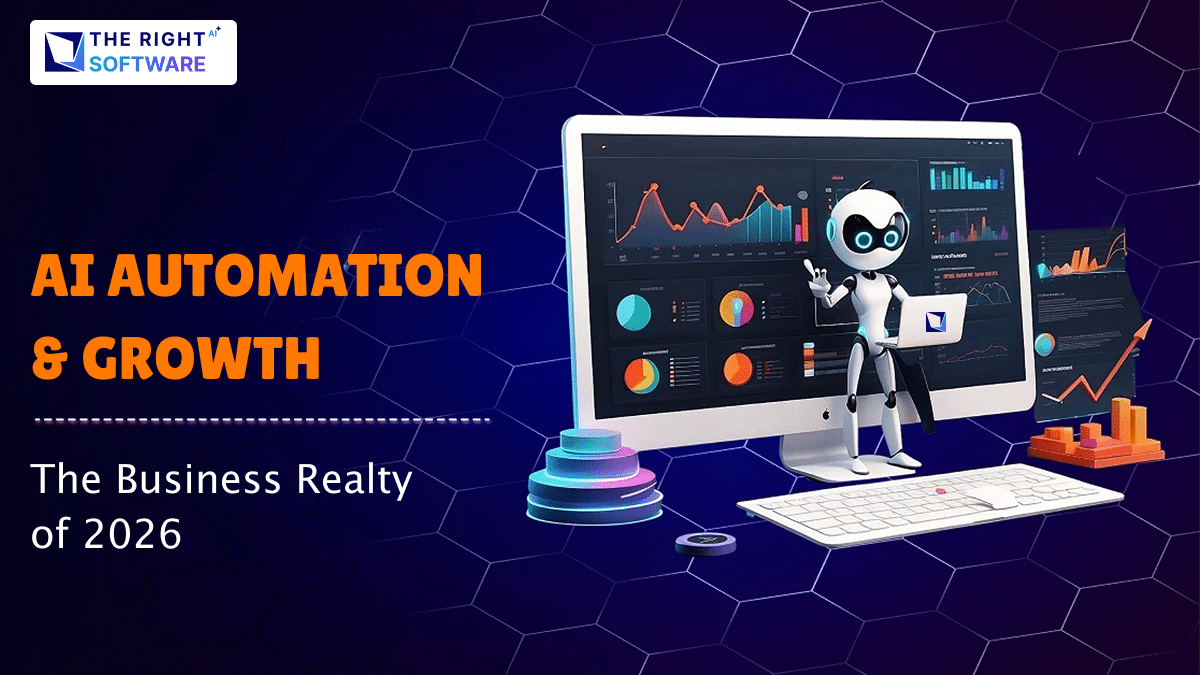
Introduction: The New Business Baseline of 2026
By 2026, growth no longer rewards effort. It rewards structure.
Hiring faster, working longer, and pushing harder once signaled momentum. Today, those behaviors often expose inefficiency. The businesses pulling ahead are not running faster—they are operating smarter.
Modern growth is engineered through systems. Efficiency, predictability, and adaptability have replaced urgency and heroics as the true drivers of scale. Companies that scale sustainably do not rely on pressure. They rely on infrastructure.
AI and automation did not arrive as a dramatic disruption. They became embedded quietly—inside CRMs, analytics, customer support, finance, and internal workflows—until they stopped being optional and became expected.
Customers now demand instant, consistent experiences. Teams expect clarity and reduced manual work. Leaders expect real-time visibility into performance and risk. These expectations cannot be met reliably without automation.
AI provides the intelligence. Automation delivers execution. Together, they define how modern businesses operate, adapt, and scale.
This article breaks down the business reality of 2026—why AI and automation are now baseline requirements, how they directly influence revenue and market position, where most implementations fail, and why system-driven development models are becoming the foundation of sustainable growth.
Why AI and Automation Are No Longer Competitive Advantages
The Transition From Innovation to Infrastructure
In the early phases of digital transformation, AI adoption was a signal of innovation. Businesses highlighted chatbots, predictive analytics, and automated reporting as differentiators. These tools demonstrated forward thinking and technical maturity.
By 2026, that narrative no longer applies.
AI has become infrastructure. Much like cloud computing, payment gateways, or cybersecurity systems, it operates in the background. When implemented well, it is invisible. When missing, its absence is immediately noticeable through delays, inconsistency, and operational friction.
Customers no longer reward companies for using AI. They expect it. What they notice instead are slow responses, inaccurate information, repetitive interactions, and broken workflows. These failures are now interpreted as signs of poor management rather than technical limitations.
The competitive advantage is no longer access to AI. It is the depth of integration. Businesses that embed AI directly into their core processes outperform those that treat it as an add-o
| **Earlier AI Adoption (Innovation Phase)** | **AI in 2026 (Infrastructure Phase)** |
| ------------------------------------------ | ------------------------------------- |
| Used to impress customers or investors     | Used to meet baseline expectations    |
| Implemented as standalone tools            | Embedded across core systems          |
| Optional experiments                       | Non-negotiable operations             |
| Managed by small innovation teams          | Owned by operations and leadership    |
| Focused on features                        | Focused on reliability and outcomes   |
| Failure was acceptable                     | Failure creates immediate friction    |
| Measured by novelty                        | Measured by consistency and speed     |
Automation as a Market Expectation
Modern markets operate at digital speed. Whether in B2B or B2C environments, customers expect consistent experiences regardless of time, channel, or volume. These expectations include immediate acknowledgment, accurate responses, predictable delivery, and fast resolution of issues.
Meeting these standards manually is increasingly unrealistic. Human performance varies with workload, fatigue, and context. Automation removes this variability by enforcing consistent execution.
For example, automated customer routing ensures every inquiry reaches the appropriate team without delay. Automated onboarding ensures every customer receives the same information and setup process. Automated reporting ensures decision-makers see the same data, updated in real time.
When these systems are absent, inconsistencies accumulate. Over time, trust ero
The Hidden Cost of Staying Manual
Many organizations delay automation due to perceived cost, complexity, or fear of disruption. These concerns are understandable but incomplete.
The true cost of manual systems is often hidden. Leadership spends excessive time coordinating work instead of setting strategy. Teams waste hours reconciling data across disconnected tools. Errors multiply as volume increases. Decision-making slows because information is fragmented or outdated.
In 2026, inefficiency is no longer a neutral condition. It directly limits competitiveness. Businesses that remain heavily manual struggle to keep pace, regardless of talent or ambition.
Automation as the Foundation of Scalable Growth
Why Traditional Growth Models No Longer Work
Historically, growth followed a predictable pattern. Increased demand led to hiring. Hiring led to expanded management structures. Operations became more complex with each layer added.
This model struggles in modern markets. Labor costs rise faster than revenue. Skilled talent is harder to recruit and retain. Communication overhead increases with team size. Operational consistency becomes difficult to maintain.
Automation changes this equation. It allows businesses to increase output without proportional increases in headcount. This does not eliminate human roles. It reallocates them toward higher-value work that requires judgment, creativity, and strategic thinking.
Systems Replace Manual Effort
Automated systems execute repetitive tasks reliably. They do not forget steps, misinterpret instructions, or vary based on workload. This consistency is critical because growth amplifies weaknesses.
A minor inefficiency at low volume becomes a serious bottleneck at scale. Automation prevents this by enforcing structure.
For example, automated invoicing ensures accuracy and timeliness as transaction volume grows. Automated inventory management prevents shortages and overstock. Automated compliance checks reduce risk without slowing operations.
IF customer signs contract
→ Create account
→ Assign onboarding flow
→ Schedule automated check-ins
→ Monitor engagement signals
→ Alert human only if risk detected
Predictability Enables Strategic Decision-Making
Automation improves predictability across operations. Real-time data replaces delayed reports. Trends become visible earlier. Anomalies are detected before they escalate.
This visibility allows leaders to plan proactively. Marketing budgets align more closely with performance. Sales forecasts become more accurate. Product decisions rely on usage data rather than assumptions.
As a result, growth becomes intentional rather than reactive.
if churn_rate > acceptable_threshold:
    trigger_action("customer_success_review")
Quality and Speed Are No Longer Trade-Offs
A common misconception is that automation sacrifices quality for efficiency. In practice, the opposite is often true.
Automation enforces standards. It ensures processes are followed correctly. Human teams are freed to focus on tasks that require judgment, empathy, and creativity.
This balance allows businesses to move faster while maintaining or improving quality.
The Direct Link Between Automation, Revenue, and Market Position
Speed as a Revenue Driver
Speed directly influences revenue at every stage of the customer journey. Faster responses increase conversion rates. Faster onboarding improves activation. Faster support resolution increases retention.
Automation accelerates these processes without increasing operational strain. For example, automated lead scoring allows sales teams to prioritize effectively. Automated follow-ups ensure no opportunity is missed.
def score_lead(engagement_level, company_size, intent_signal):
    score = 0

    if engagement_level == "high":
        score += 40
    if company_size > 50:
        score += 30
    if intent_signal:
        score += 30

    return score
Reducing Revenue Leakage
Revenue leakage occurs when value is lost due to inefficiency rather than lack of demand. Common sources include missed follow-ups, billing errors, slow support responses, and internal misalignment.
Automation closes these gaps by connecting systems and standardizing workflows. Over time, the cumulative impact is substantial. Businesses retain more value from existing demand.
Market Resilience Through Systems
Automated businesses adapt more easily to change. Pricing updates deploy quickly. New workflows roll out smoothly. Teams adjust without disruption.
Manual businesses struggle to respond at the same pace. Changes require retraining, coordination, and extended timelines. In volatile markets, this difference determines survival.
A Practical Comparison
Consider two similar companies entering 2026. One operates with manual reporting, disconnected tools, and project-based development. The other uses integrated systems, automated analytics, and continuous development support.
Even with similar talent and offerings, the second company compounds advantages faster. Execution improves. Costs remain controlled. Customer experience strengthens. The gap widens over time.
Why Most Businesses Fail at AI Implementation
Treating AI as a Shortcut
One of the most common mistakes is expecting AI to fix structural problems instantly. Businesses adopt tools without redesigning workflows.
AI does not replace process design. It amplifies it. Without clear workflows, AI outputs become unreliable. Teams lose trust. Adoption stalls.
Fragmented Technical Ownership
Many companies rely on short-term freelancers or multiple vendors for implementation. While this may reduce initial cost, it introduces long-term instability.
When ownership is fragmented, no one understands the full system. Maintenance becomes difficult. Improvements slow. AI systems degrade without continuous care.
One-Time Thinking in a Continuous Environment
AI is not static. Models evolve. Data patterns change. Business needs shift.
Treating AI implementation as a one-time project ignores this reality. Successful businesses view AI as an evolving capability that requires ongoing development, monitoring, and optimization
The Rise of Dedicated Monthly Development Models
Why Project-Based Development Falls Short
Project-based development assumes fixed requirements. AI-driven systems rarely remain fixed.
As insights emerge, workflows must adapt. Automation must be refined. Project-based models make this expensive and slow.
Continuity Creates Long-Term Value
Dedicated monthly teams provide continuity. Developers understand the product deeply. Knowledge accumulates rather than disappearing.
This continuity improves decision-making, reduces technical debt, and accelerates execution.
Predictable Costs, Flexible Priorities
Monthly models offer predictable budgeting while allowing priorities to shift based on performance data. This flexibility supports experimentation without financial uncertainty.
How DevProvider Supports AI-Ready Growth
A Systems-First Development Approach
DevProvider focuses on building systems rather than isolated features. Automation is designed to integrate across departments, creating cohesive operations.
Dedicated Teams, Not Disposable Resources
Through a dedicated monthly model, DevProvider provides consistent teams that grow with the product. Accountability, continuity, and velocity improve over time.
Gradual, Controlled Implementation
Automation initiatives often fail due to disruption. DevProvider emphasizes phased implementation, allowing teams to adapt without operational shock.
Organizational Change and Culture: The Human Side of Automation
Why Technology Alone Is Not Enough
Many automation initiatives fail not because of technology, but because of resistance to change. Systems alter how people work, make decisions, and measure success.
Without cultural alignment, even well-built automation is underutilized.
Shifting From Heroics to Systems Thinking
High-performing manual organizations often celebrate individual heroics. Automation shifts value toward consistency and design.
Leaders must reinforce that systems do not replace people; they protect them. Automation removes low-value work so teams can focus on impact.
Building Trust in Automated Decisions
Trust is essential. Teams must understand how systems work, what data they use, and where human oversight applies.
Transparent design, clear escalation paths, and ongoing training build confidence.
Leadership’s Role in Adoption
Leaders set the tone. When leadership relies on automated insights, teams follow. When leaders bypass systems, adoption stalls.
Cultural change succeeds when automation is modeled, not mandated.
Industry-Specific Case Examples: How Automation Plays Out in Practice
SaaS Companies: Scaling Without Breaking the Product
In SaaS businesses, growth often exposes weaknesses faster than in any other model. User acquisition can scale rapidly through digital channels, but onboarding, support, billing, and infrastructure must keep pace.
Automation becomes the stabilizing force. AI-driven onboarding flows guide users based on behavior rather than static tutorials. Automated monitoring detects performance issues before customers experience them. Usage analytics feed directly into product roadmaps.
SaaS companies that rely on manual customer success and reactive support struggle as user bases grow. Those that automate lifecycle management scale revenue while keeping churn under control.
Service-Based Businesses: Turning Expertise Into Systems
Professional services traditionally scale through people. More clients require more consultants, more managers, and more coordination. This creates thin margins and operational fragility.
Automation changes the model. Proposal generation, scheduling, reporting, and billing can be systematized. AI assists with research, documentation, and analysis. Delivery becomes more consistent, regardless of team size.
Service firms that systemize their expertise move from time-based scaling to leverage-based growth.
Enterprise Organizations: Reducing Complexity at Scale
Enterprises face a different challenge: scale already exists, but inefficiency hides inside complexity. Disconnected departments, legacy systems, and manual approvals slow execution.
Automation integrates systems across finance, HR, operations, and customer engagement. AI-driven analytics surface insights that were previously buried. Decision cycles shorten.
Enterprises that modernize infrastructure gain agility without sacrificing control.
Startups: Building for Scale From Day One
Startups that embed automation early avoid painful rebuilds later. Instead of layering tools reactively, they design workflows intentionally.
AI supports rapid experimentation. Automation reduces operational drag. Founders spend less time managing processes and more time validating markets.
Startups that delay system design often hit a growth ceiling that requires costly restructuring.
Looking Ahead: What 2027–2030 Will Reward
System Maturity Over Tool Adoption
Future advantage will not come from using the newest AI tools. It will come from how mature, integrated, and adaptable systems are.
Businesses with clean data, modular workflows, and continuous optimization will outperform those chasing trends.
Continuous Learning Organizations
AI will accelerate feedback loops. Companies that learn quickly from data and adjust processes continuously will compound advantages.
Static organizations will fall behind, regardless of size.
Human Judgment as a Premium Skill
As automation handles execution, human value shifts toward judgment, ethics, creativity, and strategy.
Organizations that develop these skills alongside automation will lead.
Resilience Through Design
Economic volatility, regulatory change, and market disruption will continue. Businesses built on adaptable systems will absorb shocks more effectively.
Resilience will be engineered, not improvised.
Final Perspective
The next phase of growth will reward businesses that think in systems, invest in infrastructure, and commit to continuous improvement.
AI and automation are no longer about efficiency alone. They are about building organizations capable of evolving.
Growth beyond 2026—and into 2030—belongs to companies that engineer it deliberately, with people, processes, and technology aligned.