
Retrieval-Augmented Generation (RAG) has quickly become one of the most adopted architectural patterns in modern AI systems. Enterprises across industries are using RAG to combine Large Language Models (LLMs) with proprietary data, internal knowledge bases, policies, and continuously evolving documents.
On the surface, RAG seems straightforward: embed documents, store them in a vector database, retrieve relevant chunks, and pass them to an LLM. This simplicity is exactly why many teams believe they have “built RAG” — and why so many systems quietly fail in production.
At The Right Software, we consistently observe the same pattern. RAG systems work well in demos, proofs of concept, and internal pilots. But once exposed to real users, real traffic, and real organizational constraints, performance degrades, trust erodes, and operational costs spiral.
Organizations investing in AI solutions for enterprises are quickly realizing that building production-grade RAG pipelines requires more than simple vector search.
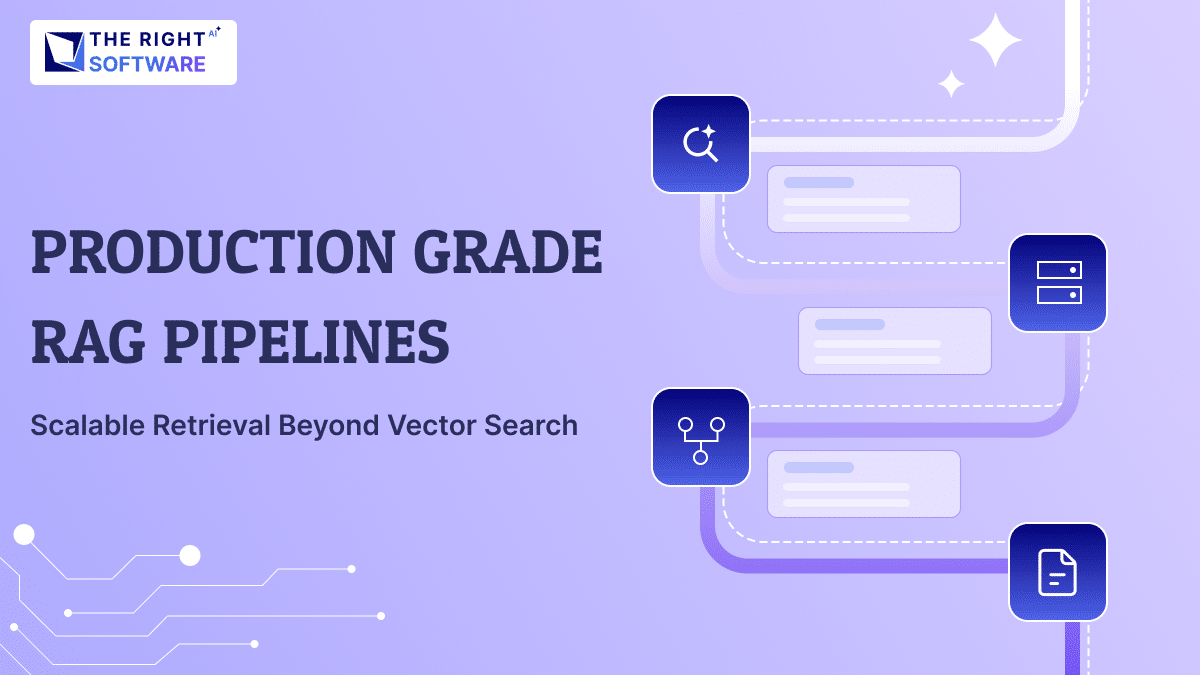
This blog explores what it truly takes to design production-grade RAG pipelines — systems that move beyond simple vector search and are engineered for accuracy, scalability, reliability, security, and long-term sustainability.
Why Simple Vector Search Fails in Real-World RAG Systems
Vector search is powerful — but it is not intelligent.
Early RAG implementations rely heavily on dense embeddings and top-k similarity search. During early testing, this approach appears effective because:
Datasets are small and clean
Queries are well-phrased
Latency and cost are not yet critical
Access control is often ignored
Once real users arrive, the cracks begin to show.
Users ask vague, incomplete, or ambiguous questions. Content changes frequently. Some documents become outdated while others gain importance. Compliance, authorization, and data sensitivity suddenly matter.
Pure vector similarity cannot reason about:
Document freshness
Source authority
Business relevance
User permissions
Organizational context
As a result, systems surface outdated policies, low-quality documents, or information the user should never see. These failures are often blamed on the LLM — but in reality, retrieval is the weakest link.
Discover More: What is a Vector Database & How Does it Work?
What “Production-Grade” Really Means for RAG
“Production-grade” does not mean “deployed.”
A production-ready RAG system must operate reliably under imperfect data, unpredictable users, fluctuating traffic, and strict security requirements.
A truly production-grade RAG pipeline demonstrates:
Consistent accuracy across diverse queries
Stable latency under load
Strong observability and debuggability
Strict security and access enforcement
Predictable and controllable costs
Clear failure modes and graceful degradation
If any of these properties are missing, user trust erodes — and in enterprise environments, lost trust is rarely recovered.A production-grade RAG pipeline is not just an LLM feature; it is part of a broader enterprise AI architecture that must integrate data pipelines, security layers, and scalable infrastructu
RAG must be treated as a distributed AI system, not a feature.
| Aspect | Demo / PoC RAG | Production-Grade RAG (TRS Approach) |
|---|---|---|
| Data Size | Small, static | Large, dynamic, continuously changing |
| Chunking | Fixed-size | Semantic, structure-aware |
| Retrieval | Vector-only | Hybrid (dense + sparse + metadata) |
| Access Control | None or basic | Role & document-level enforcement |
| Latency Handling | Ignored | SLAs, timeouts, fallbacks |
| Observability | Minimal | Full pipeline metrics & audit logs |
| Cost Awareness | Not tracked | Budgeted and optimized |
Data Ingestion: The Hidden Determinant of RAG Quality
Data ingestion is the most underestimated component of RAG — and one of the most damaging when done poorly.
Enterprise data is messy:
PDFs contain layout artifacts
Word documents mix formatting and meaning
Web pages include navigation clutter
Spreadsheets encode semantics through structure
Knowledge bases contain duplicated or outdated content
Embedding this data “as is” pollutes the vector space. Irrelevant tokens dominate embeddings. Semantically unrelated chunks appear similar. Retrieval quality degrades silently.
What looks like hallucination is often poor ingestion design.
Semantic Chunking: Preserving Meaning at Scale
Advanced document processing pipelines use semantic chunking to preserve meaning while scaling across large document collections, ensuring retrieval remains accurate and relevant.
Chunking determines how knowledge is represented.
Fixed-size chunking optimizes for simplicity, not understanding. It splits content based on token count, often separating definitions from explanations and destroying logical flow.
Production-grade RAG systems use semantic chunking, where chunks align with human-readable structure:
Headings and subheadings remain intact
Tables and lists are preserved
Definitions stay connected to explanations
Contextual relationships are maintained
Each chunk represents a complete idea, not an arbitrary slice of text. This dramatically improves retrieval precision and downstream generation quality.
from langchain.text_splitter import MarkdownHeaderTextSplitter

headers = [
    ("#", "section"),
    ("##", "subsection"),
]

splitter = MarkdownHeaderTextSplitter(headers)

chunks = splitter.split_text(document_text)

for chunk in chunks:
    print(chunk.metadata, chunk.page_content[:200])
Metadata: The Control Plane of RAG Systems
Metadata is not optional — it is foundational.
Vector embeddings capture meaning, but ignore context. Metadata provides the signals that production systems depend on.
Critical metadata includes:
Source system
Document owner and department
Creation and last-updated timestamps
Version identifiers
Sensitivity and access classification
Approval or authority level
Metadata enables:
Freshness prioritization
Source-aware ranking
Role-based access enforcement
Auditability and traceability
In enterprise RAG, metadata functions as a retrieval control plane, guiding what should be retrieved — not just what can be retrieved.
| Metadata Field | Purpose | Impact on Retrieval |
|---|---|---|
| Source System | Identify origin | Boost trusted systems |
| Owner / Dept | Authority context | Prefer official docs |
| Last Updated | Freshness | Avoid outdated content |
| Sensitivity Level | Security | Enforce access control |
| Version ID | Consistency | Prevent mixed versions |
| Approval Status | Compliance | Filter drafts |
Retrieval Intelligence: Moving Beyond Similarity
Vector similarity answers one question: “Is this text related?”
Production systems must answer a harder one: “Is this the right information for this user, right now?”
Hybrid Retrieval as the Enterprise Baseline
Production-grade RAG pipelines use hybrid retrieval, combining:
Dense vector search (semantic similarity)
Sparse keyword search (exact terms, acronyms)
Metadata filtering (permissions, freshness)
Rule-based boosts (authority, priority sources)
This layered approach consistently outperforms vector-only retrieval and significantly reduces irrelevant or outdated results.
results = vector_store.similarity_search(
    query="SOC 2 compliance policy",
    k=10,
    filter={
        "department": "Security",
        "approval_status": "approved"
    }
)
Reranking: The Last Line of Defense
Even strong retrieval systems return noisy candidates.
Rerankers act as a quality gate, evaluating retrieved chunks with deeper query-document understanding. Only the most relevant context is passed to the LLM.
While computationally expensive, reranking:
Reduces hallucinations
Improves answer precision
Lowers token usage
Increases user trust
In production, reranking is not optional — it is a reliability requirement
| Stage | Function | Failure Risk Mitigated |
|---|---|---|
| Initial Retrieval | Broad recall | Missed context |
| Metadata Filtering | Enforce rules | Data leakage |
| Reranking | Precision | Irrelevant chunks |
| Context Selection | Token budget | Noise overload |
| Generation | Grounded output | Hallucinations |
Query Understanding and Intent Modeling
Users do not speak in structured queries. They use shorthand, omit context, and assume shared understanding.
Production RAG systems perform query understanding before retrieval:
Query rewriting and expansion
Intent classification
Domain detection
Risk and sensitivity assessment
A query like “SOC 2” could mean:
What is SOC 2?
Are we SOC 2 compliant?
How do we prepare for a SOC 2 audit?
Intent modeling ensures the system retrieves the right type of content — not just related content.
Prompt Orchestration as System Logic
Prompts are not static text. In production systems, they are executable policy.
Prompt orchestration adapts instructions based on:
User role and permissions
Query intent
Risk profile
Output format requirements
A legal query demands conservative language and citations. A support query demands clarity and brevity. An internal research query allows exploration.
Dynamic orchestration enforces consistency, safety, and trust at scale.
Context Window Management and Token Discipline
More context is not better context.
Large context windows increase cost, dilute relevance, and can confuse the model. Production pipelines aggressively curate context through:
Metadata filtering
Reranking
Token budgeting
Priority ordering
High-quality, minimal context consistently outperforms large, noisy context — at lower cost.
Grounded Generation and Hallucination Control
LLMs are probabilistic. When uncertain, they guess.
Production-grade RAG systems constrain generation through:
Strict grounding to retrieved context
Citation enforcement
Refusal policies for missing data
Confidence signaling
These controls prevent fabricated answers and are essential in regulated or high-risk environments.
Observability, Evaluation, and Continuous Improvement
RAG systems degrade without feedback.
Production pipelines track:
Retrieval precision and recall
Answer faithfulness
Latency per stage
Token usage and cost per request
Human feedback complements automated metrics. User ratings, error tagging, and retrieval audits reveal blind spots and guide iteration.
Scaling RAG for Real Traffic
Traffic is unpredictable. Scaling must be designed upfront.
Asynchronous Pipelines
Parallelizing retrieval, reranking, and context assembly reduces latency and improves throughput.
Load-Balanced Vector Stores
Single-node vector databases fail under load. Replication and load balancing are mandatory for reliability.
Request Batching
Batching embeddings and retrieval requests reduces overhead and stabilizes costs.
Fail-Safe Timeouts
When dependencies fail, systems must degrade gracefully — not block indefinitely.
try:
    context = retrieve_context(query, timeout=2.0)
except TimeoutError:
    context = fallback_summary
Security and Access Control: Non-Negotiable
Enterprise RAG systems handle sensitive data.
Security requirements include:
Role-based access control
Document-level permissions
Prompt injection defenses
Full audit logs
Access control must be enforced before retrieval, ensuring unauthorized data never reaches the model.
Cost Optimization as an Architectural Principle
RAG systems can become expensive silently.
Production systems optimize through:
Intelligent caching
Selective retrieval
Smaller models where appropriate
Context minimization
Cost control is a design decision, not a post-launch fix.
When RAG Is Not the Right Solution
RAG is powerful — but not universal.
Deterministic workflows, transactional systems, or strict compliance flows may require fine-tuned models, rule engines, or tool-calling architectures.
Mature AI systems combine multiple patterns thoughtfully.
| Use Case | RAG | Better Alternative |
|---|---|---|
| Policy Q&A | ✅ | — |
| Compliance workflows | ⚠️ | Rule engines |
| Financial calculations | ❌ | Deterministic logic |
| Customer support | ✅ | RAG + tools |
| Transactions | ❌ | APIs / services |
How TRS Designs and Operates Production-Grade RAG Systems
At The Right Software, we do not treat RAG as an experimental feature or a thin layer on top of a language model. We design RAG systems as long-lived, mission-critical platforms that must perform reliably under real-world enterprise constraints.
Our approach is grounded in one principle: retrieval quality is a systems problem, not a model problem.
At a high level, TRS RAG systems follow a gated retrieval architecture: ingestion → hybrid retrieval → reranking → governed generation → observability.
RAG as an End-to-End Architecture, Not a Stack of Tools
Rather than assembling disconnected components, The Right Software engineers RAG pipelines as cohesive systems. We design ingestion, retrieval, orchestration, and generation as tightly integrated layers with explicit contracts between them.
Every RAG engagement at The Right Software begins with architectural decisions around:
Data ownership and authority boundaries
Update frequency and document lifecycle
Access control models
Latency and cost budgets
These decisions shape the pipeline long before any model or vector database is selected.
Enterprise-Grade Ingestion Built for Change
The Right Software builds ingestion pipelines that assume data will change — frequently and unpredictably.
We implement:
Structured document parsing for PDFs, DOCX, HTML, and spreadsheets
Semantic chunking aligned to domain-specific content structures
Version-aware embeddings that preserve historical context
Incremental re-indexing to avoid full rebuilds
This ensures that retrieval quality improves over time rather than degrading silently.
Retrieval Intelligence Tailored to Organizational Context
At The Right Software, retrieval is never “one size fits all.”
We design hybrid retrieval strategies that blend:
Dense semantic search
Sparse keyword and acronym matching
Metadata-driven filtering and boosts
Authority and freshness scoring
Retrieval behavior is customized by domain, user role, and query intent — ensuring that the system surfaces the right information, not just similar text.
Controlled Generation with Explicit Trust Boundaries
The Right Software systems are designed to minimize hallucination risk by design, not by prompt tweaking.
We enforce:
Strict grounding to retrieved sources
Context attribution and citation enforcement
Refusal paths when evidence is insufficient
Confidence signaling for uncertain responses
These guardrails are essential for compliance-heavy and high-stakes enterprise environments.
Production-Ready Observability and Governance
A RAG system that cannot be observed cannot be trusted.
The Right Software builds deep observability into every deployment, including:
Retrieval accuracy tracking
Source-level contribution analysis
Latency and cost per pipeline stage
Audit logs for every query and response
This allows teams to debug failures, justify decisions, and continuously improve system performance.
Built to Scale from Day One
The Right Software designs RAG systems assuming success — and success means scale.
Our deployments include:
Horizontally scalable vector stores
Asynchronous retrieval and reranking
Request batching and intelligent caching
Fail-safe degradation strategies
The result is predictable performance even under sudden traffic spikes.
A Pragmatic View: RAG Where It Makes Sense
Importantly, The Right Software does not force RAG where it does not belong.
We routinely combine RAG with:
Deterministic workflows
Tool-based reasoning
Rule engines and policy enforcement
Fine-tuned or domain-specific models
This hybrid approach ensures that AI systems remain reliable, auditable, and aligned with business realities.
Why Enterprises Partner with TRS
Organizations work with The Right Software not just to “implement RAG,” but to operate AI systems they can trust.
Our clients value:
Production-first design philosophy
Deep systems engineering expertise
Security- and compliance-aware architectures
Long-term maintainability over short-term demos
RAG succeeds when it is engineered — not assembled.
Final Perspective: RAG Is Systems Engineering
RAG is not about prompts or vector databases.
It is about engineering resilient systems that integrate data, retrieval, generation, security, and operations — reliably and at scale.
Organizations that treat RAG as systems engineering move beyond experimentation. They build AI systems users trust and depend on.
Choosing the Right Approach
If you are designing or scaling an enterprise RAG system, Thr Right Software can help you build it correctly from the ground up.
Book a free consultation with our experts and move beyond simple vector search toward truly production-grade RAG pipelines.